MercoPress. South Atlantic News Agency
Venezuela
-
Thursday, June 25th 2026 - 09:30 UTC
Two powerful earthquakes strike northern Venezuela and collapse buildings in Caracas
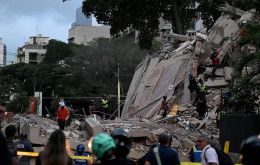
Two powerful earthquakes of magnitude 7.2 and 7.5, about 39 seconds apart, struck north-central Venezuela on Wednesday afternoon, collapsing buildings in the capital, Caracas, and leaving rescue teams working through the rubble, according to the US Geological Survey (USGS). Acting President Delcy Rodríguez declared a state of emergency, though she did not provide figures for the injured or dead.
-
Thursday, June 25th 2026 - 09:04 UTC
Venezuela's earthquake toll rises to at least 164 dead and nearly 1,000 injured
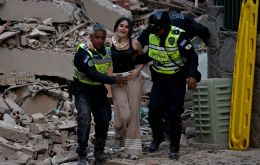
The number of victims from the twin earthquake that struck north-central Venezuela rose to at least 164 dead and 971 injured, acting President Delcy Rodríguez reported on Thursday, warning that the figure would keep rising as rescue work progressed. The quakes, of magnitude 7.2 and 7.5, hit on Wednesday afternoon and left dozens of buildings collapsed across several regions of the country.
-
Thursday, June 25th 2026 - 06:41 UTC
Offers of aid pour in for Venezuela from across the Americas and beyond after its earthquake
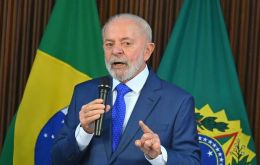
Governments from across the Americas and other regions of the world expressed solidarity with Venezuela and offered assistance after the twin earthquake of magnitude 7.2 and 7.5 that struck the north-central part of the country on Wednesday and that, according to the first official toll, left at least 32 dead and more than 700 injured. Several countries announced the dispatch of rescue teams, while acting President Delcy Rodríguez thanked them for the shows of support.
-
Thursday, June 25th 2026 - 05:59 UTC
Venezuela's earthquake tests US assistance to the interim government it helped install
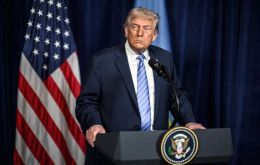
The twin earthquake that struck north-central Venezuela has become the first major test of US assistance to the interim government of Delcy Rodríguez, installed after the capture of former president Nicolás Maduro in a US military operation in January. Washington mobilized rescue teams and supplies for a country with which, until half a year ago, it maintained no cooperative relations.
-
Friday, June 19th 2026 - 06:49 UTC
US-backed opposition figure Figuera returns to Venezuela to negotiate a 'credible' electoral body
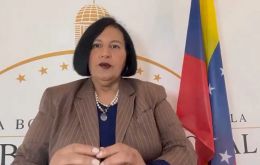
Opposition figure Dinorah Figuera, president of the National Assembly elected in 2015 and exiled in Spain for nearly eight years, returned to Venezuela on Thursday at the invitation of the US State Department to negotiate a “credible” electoral authority with Delcy Rodríguez's interim government. The return is part of Washington's plan for a democratic transition in the country.
-
Wednesday, June 17th 2026 - 08:31 UTC
Spain's ex-PM Zapatero testifies as a suspect in the Plus Ultra bailout case
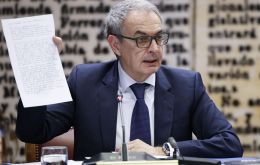
Spain's former Prime Minister José Luis Rodríguez Zapatero appeared on Wednesday before Judge José Luis Calama, of the Audiencia Nacional, as an investigated person in the Plus Ultra case, in what constitutes an unprecedented event in Spanish democracy: it is the first time a former head of the Executive sits before a magistrate as a suspect. He will answer questions from the judge and his lawyer, but not from the Anti-Corruption prosecutor.
-
Saturday, June 13th 2026 - 19:02 UTC
Trump says a US strike killed Niño Guerrero, leader of Venezuela's Tren de Aragua gang

US President Donald Trump announced on Friday night that his country's Southern Command had killed, in a “swift and lethal” strike, Héctor Rusthenford Guerrero Flores, alias Niño Guerrero, whom he described as the leader of Tren de Aragua, “one of the most bloodthirsty terrorist organizations on the planet.” Venezuela's government confirmed hours later the death of the criminal boss, which occurred in Bolívar state, in the country's southeast.
-
Thursday, June 11th 2026 - 23:12 UTC
Venezuela hands Shell a license for the cross-border Loran gas field shared with Trinidad
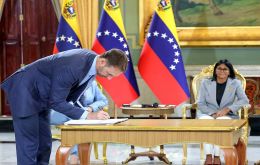
Venezuela on Thursday granted the British company Shell a license for a first phase of exploration and exploitation of the Loran gas field, which has seven reservoirs, six of them transboundary with Trinidad and Tobago. The signing was led by acting President Delcy Rodríguez at Miraflores Palace, the seat of the Venezuelan government.
-
Tuesday, June 9th 2026 - 06:59 UTC
Venezuela's Cabello rejects Machado's offer of talks with the chavista leadership
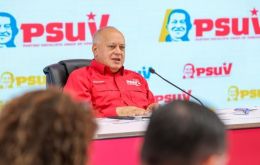
Venezuela's Interior, Justice and Peace Minister and secretary general of the United Socialist Party of Venezuela (PSUV), Diosdado Cabello, on Monday ruled out any political negotiation with opposition leader María Corina Machado and with the Democratic Unitary Platform, days after the opposition made an unprecedented offer to sit down for talks with chavismo. “There is nothing on the table with them, and even less with her,” he said.
-
Thursday, June 4th 2026 - 15:28 UTC
Venezuela moves to open its power sector to private investment after years of blackouts

Venezuela's National Assembly gave initial approval to a reform of the electricity law that opens the sector to private investment through long-term concessions, in an effort to reverse the collapse of a service battered by blackouts for two decades. The measure ends the monopoly held for more than 15 years by the state-owned National Electric Corporation (Corpoelec), though it still requires a second debate and final ratification in the coming days.
