MercoPress. South Atlantic News Agency
Venezuela
-
Friday, August 28th 2026 - 14:15 UTC
Washington negotiates stakes in Venezuelan oil fields with leases of up to a century

The United States government is negotiating with Venezuela's interim administration to acquire stakes in a group of the South American country's oil fields, under arrangements that would include leases of up to a hundred years, the outlets Axios and Bloomberg reported on Thursday citing unnamed senior US officials.
-
Monday, August 24th 2026 - 21:37 UTC
Colombia orders deportation of irregular migrants after a decade as the main host country
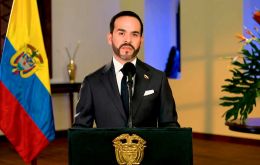
Colombian President Abelardo de la Espriella has ordered coordinated operations between the migration authority and the police to begin this week to identify and deport foreigners without regular migration status, marking a shift from the policy the country has maintained for more than a decade as the main destination for Venezuelan migration.
-
Friday, August 21st 2026 - 08:17 UTC
BP, Shell and Gulf partners return to Venezuelan gas on the Trinidad and Tobago border
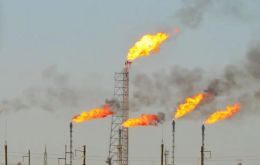
Venezuela's government has concluded a series of agreements with international oil companies in recent weeks to develop its offshore gas fields, marking a shift from the years of isolation and sanctions that have defined the sector.
-
Monday, August 17th 2026 - 07:45 UTC
Rains in Caracas leave three dead and destroy tents housing earthquake survivors
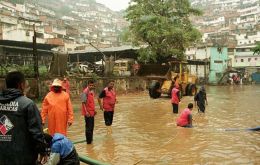
At least three people died in Caracas as a result of torrential rains that fell between Saturday night and the early hours of Sunday, which also caused flooding, brought down trees, cut power supplies and destroyed camps sheltering families left homeless by the double earthquake of June 24.
-
Thursday, August 13th 2026 - 08:59 UTC
Venezuela's government and opposition agree to renew the Supreme Court and claim the London gold
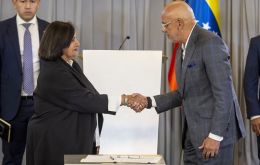
The government of acting president Delcy Rodríguez and a section of Venezuela's opposition closed the first round of negotiations in Caracas on Wednesday with two agreements: restarting from scratch the renewal of the Supreme Court of Justice, and acting jointly to recover Venezuelan gold reserves held at the Bank of England.
-
Tuesday, August 11th 2026 - 10:11 UTC
Colombia and Venezuela quakes are unconnected despite similar magnitude, experts say
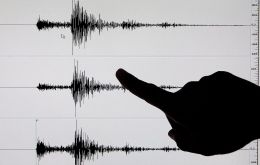
The magnitude 7.4 earthquake that struck western and central Colombia on Monday has a different tectonic origin from the earthquakes recorded in Venezuela in June, despite comparable magnitudes, said Viviana Dionisio, a seismologist with Colombia's National Seismological Network.
-
Sunday, August 9th 2026 - 20:05 UTC
Machado congratulates De la Espriella and says Venezuela will soon follow suit
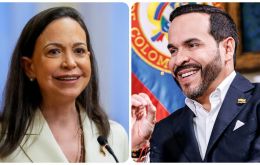
Venezuelan opposition leader and 2025 Nobel Peace Prize laureate María Corina Machado congratulated Colombia's new president, Abelardo de la Espriella, and said Venezuela would “very soon” undertake a process of institutional and democratic strengthening similar to the one she said is beginning in the neighboring country. The Colombian president replied on Sunday thanking her for the support.
-
Friday, August 7th 2026 - 21:17 UTC
Venezuelan government and opposition open US-backed talks
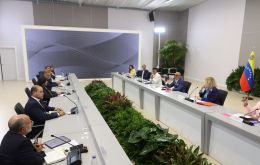
Delegations from the Venezuelan government and one sector of the opposition met on Thursday in Caracas to open negotiations backed by the United States, in the first face-to-face encounter since Nicolás Maduro's detention by US forces on January 3.
-
Thursday, July 23rd 2026 - 22:37 UTC
World Bank estimates $19.6 billion in earthquake damage in Venezuela
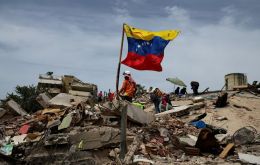
The twin earthquakes that struck northern Venezuela on June 24 caused an estimated $19.6 billion in direct physical damage, according to a preliminary assessment published on Thursday by the World Bank. The figure is equivalent to about 18% of the country's gross domestic product, based on International Monetary Fund data.
-
Thursday, July 23rd 2026 - 07:34 UTC
New York judge sets June 2027 for the start of Maduro and Cilia Flores's trial
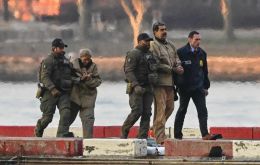
Federal Judge Alvin Hellerstein set June 1, 2027, as the preliminary start date for the trial of former Venezuelan president Nicolás Maduro and his wife, Cilia Flores, in the narcoterrorism case they face in the United States. The decision came on Wednesday during the case's third hearing before the US District Court for the Southern District of New York, which lasted only a few minutes.
