MercoPress. South Atlantic News Agency
Agriculture
-
Thursday, July 16th 2015 - 08:15 UTC
Aphids beat latest 'odor' efforts to repel them and protect GM crops

In what is described as a major blow to genetic modification of crops, a variety of wheat developed in the UK to repel pests has failed in field trials. The variety engineered to produce an odor that repels aphids, failed in the field test after it was successfully tested in the lab, proving a wide gap between lab and commercial application of the process.
-
Monday, July 13th 2015 - 09:21 UTC
Venezuela will stop buying Guyana rice amid escalating border dispute

Venezuela has decided to stop buying much of Guyana's rice crop amid an escalating border dispute between the two neighboring countries, the Guyanese finance minister said. The administration of president Nicolas Maduro has in the past four years purchased about 40% of Guyana's rice production, about 200,000 tons, paying for it with oil that amounts to about half of Guyana's daily supply needs.
-
Sunday, June 28th 2015 - 10:22 UTC
Argentina's economy picks up 1.1% during first quarter compared to a year ago

Argentina's GDP increased 1.1% during the first three months of 2015 compared to the same period last year, boosted by the domestic market and growths in the agricultural and construction sectors, the official Indec statistics bureau has revealed. This is the second quarter running that records an advance, following a drop in last year's third quarter.
-
Friday, June 5th 2015 - 10:17 UTC
FAO's Food Price Index in May was down 20.7% from a year ago

Major food commodity prices declined again in May, hitting an almost six-year low as cereal prices fell substantially amid a favorable outlook for this year's harvests. The FAO Food Price Index averaged 166.8 points in May, down 1.4% from April and as much as 20.7% from a year earlier.
-
Monday, June 1st 2015 - 07:42 UTC
Argentina's soybean crop forecasted to be comfortably above 60m tons
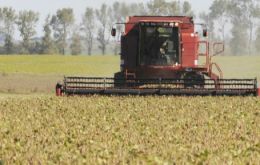
Surprising Argentina: with over 90% of the soybean crop harvested, (approximately 17.2 million hectares), the Buenos Aires Cereals Stock exchange has again risen the total 2014/15 crop estimate to over 60 million tons.
-
Monday, June 1st 2015 - 07:25 UTC
Argentine oil-crushing industry unions back to work after 26-day strike

Argentine oil crushing industry workers reached over the weekend a much disputed salary agreement, ending a 26 day strike, and hopefully resuming activities which have paralyzed the Rosario cereals and oilseeds stock market and forced a queue of over 140 vessels and barges along the Paraná river.
-
Friday, May 29th 2015 - 09:05 UTC
Oil crushers strike in Argentina on 25th day; 100 vessels delayed waiting to load

The head of an Argentine soy crushers' union expressed optimism on Thursday that a salary agreement was near and would end the strike, which has affected the key Rosario soy market.
-
Thursday, May 28th 2015 - 06:24 UTC
Libor rate rigging trial reveals “scratch my back, I'll scratch yours” dealings among traders

The trader at the centre of the Libor rate-rigging trial tried to influence other banks to manipulate the key benchmark rate to suit his own trading positions, a jury at Southwark Crown Court has heard. Tom Hayes allegedly told one trader that he had managed to keep the three-month Libor rate “artificially high”.
-
Wednesday, May 27th 2015 - 04:59 UTC
Argentine economic activity up 2% in March, but industrial production down
Good and bad news for Argentina's economy: the latest figures from the National Statistics and Census Institute (INDEC) reveal that economic activity increased 2% percent in March, compared to the same month last year, but industrial production recorded its 21st negative consecutive month in April.
-
Saturday, May 23rd 2015 - 06:06 UTC
Argentina's soy market paralyzed by oilseed crushers union three weeks strike

The soy market in Argentina's pivotal grains hub was virtually paralyzed for the fifth day on Friday as most exporters refrained from purchases in a bid to pressure the government to resolve a nearly three-week long strike among crushing workers.
