MercoPress. South Atlantic News Agency
Economy
-
Saturday, June 26th 2010 - 05:08 UTC
China ends freeze on Argentina soy-oil imports, says Buenos Aires
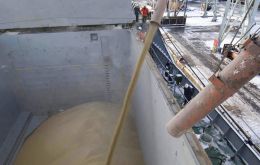
Argentina has reached an agreement with China to end the freeze on Argentine soy-oil imports, the government said on Friday. However given the cumbersome negotiation process some Argentine traders are waiting for an official confirmation from Beijing.
-
Saturday, June 26th 2010 - 05:01 UTC
BP considering sales of assets in Argentina

British Petroleum, BP, is actively considering the sale of its stake in Pan American Energy LLC, Argentina's fastest growing oil and gas company, according to oil industry sources quoted in the Buenos Aires press.
-
Friday, June 25th 2010 - 21:59 UTC
In seven years Asia became Chile’s main trade partner: absorbs 48% of exports

Between January and May of 2010, Chile shipped approximately 12.7 billion US dollars in commodities to Asia; in this five-month span, 83% of Asia-bound exports were sent to China, Japan, and South Korea.
-
Friday, June 25th 2010 - 05:17 UTC
Brazil and Argentina advance in solving bilateral trade issues

Brazil and Argentina made significant advances in outstanding bilateral trade issues following a joint meeting Thursday between top policy makers, Brazilian Finance Minister Guido Mantega told reporters.
-
Friday, June 25th 2010 - 05:14 UTC
Brazil praises Argentina’s ‘successful’ debt swap process

Brazil said on Thursday that the sovereign debt swap process led by the Argentine government and its economy administration was “successful”.
-
Thursday, June 24th 2010 - 06:07 UTC
G-20 summit: EU wants timetable to scrap stimuli; US warns recovery is still weak

The European Union (EU) has urged the G20 club of nations to agree when to scrap their economic support packages. The EU said a coordinated exit from stimulus measures would help restore confidence and reduce the risk that some countries would be disadvantaged.
-
Thursday, June 24th 2010 - 06:02 UTC
US Central bank anticipates low rates for an “extended period”

Two days ahead of the Toronto G-20 summit the US Federal Reserve anticipates it will keep its main interest rate at a near zero level, for an “extended period”. The Federal Open Market Committee said on Wednesday that “subdued inflation” and other factors “are likely to warrant” keeping rates at their historic lows.
-
Thursday, June 24th 2010 - 05:48 UTC
Brazil forecasts a drop in direct foreign investment because of European crisis

While the Brazilian economy is moving ahead at “Chinese rates” the Central Bank reduced its estimate of direct foreign investment this year from 45 to 38 billion US dollars because of the European crisis.
-
Thursday, June 24th 2010 - 05:35 UTC
China’s constructive role in global economic and financial affairs
By Dr. Ye Yu, Assistant Director of the Institute for Comparative Studies affiliated to the Shanghai Institute for International Studies (Special for People's Daily Online).The Group of Twenty (G-20) Summit (*) has opened a new page in the management of global economy and financial system, and China has played an important positive and constructive role since the First G20 Summit was held in Washington D.C. in November 2008.
-
Thursday, June 24th 2010 - 04:00 UTC
Strong austerity measures anticipate Spain will slip back into recession

The Spanish economy will slip back into recession in the second half of the year, a foundation supported by the country’s savings banks said in a publication released Wednesday.