MercoPress. South Atlantic News Agency
Economy
-
Friday, April 29th 2011 - 05:37 UTC
High interest rates in Brazil for a long period, anticipates central bank

The Brazilian central bank said it will raise interest rates at a slower pace for a longer period than initially planned as the country’s inflation outlook worsens, according to the minutes of its April 19-20 meeting.
-
Friday, April 29th 2011 - 05:21 UTC
Oil soars to its highest in 31 months and US dollar plunges to three year low

United States crude oil futures rose Thursday to hit a 31-month high settlement after a volatile trading session while the US dollar fell to a three-year low against major currencies following on the Federal Reserve's intention to keep interest rates near zero.
-
Thursday, April 28th 2011 - 18:48 UTC
EU report quantifies losses for farmers from a trade accord with Mercosur

A week before the next round of negotiations for an ambitious association and trade agreement between the European Union and Mercosur, a paper from the EU Joint Research Study centre, JRS, quantifies the alleged losses of such a deal for European farmers.
-
Thursday, April 28th 2011 - 06:49 UTC
Venezuelan industry says it’s the “worst possible moment” to join Mercosur

While for the Venezuelan government Mercosur has become the main priority following its recent exit from the Community of Andean Nations, CAN, the country’s private sector claims it is the worst moment possible for such a move.
-
Thursday, April 28th 2011 - 06:39 UTC
Brazil’s bank lending slows down as government curbs credit

Brazil’s bank lending expanded in March at the second-slowest pace in 13 months as the government stepped up efforts to contain demand and inflation by curbing credit to consumers.
-
Thursday, April 28th 2011 - 06:35 UTC
WTO members to openly discuss an alternative to the failing Doha round
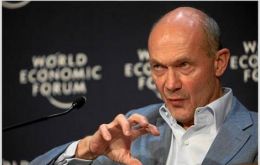
The World Trade Organization's 153 member nations will openly discuss for the first time an alternative to the failing Doha round of global trade talks, according to a report from The Wall Street Journal.
-
Thursday, April 28th 2011 - 02:38 UTC
Indian minister visits Uruguay and Argentina to promote trade with Mercosur

A top level Indian business delegation headed by Minister of state for Commerce and Industry Jyotiraditya Scindia is travelling to Argentina and Uruguay to boost ties with Mercosur, according to the Indo-Asian news agency.
-
Thursday, April 28th 2011 - 01:50 UTC
Fed in no rush to scale down liquidity support; inflation trends ‘subdued’

The Federal Reserve said on Wednesday it will maintain the current rates and is in no rush to scale back its extensive support for the US economy while estimating that the increase in commodity prices (and inflation) is transitory.
-
Thursday, April 28th 2011 - 01:39 UTC
Japan credit rating threatened by weak government and lack of political agreement

Risk rating agency Standard and Poor's threatened to cut Japan's sovereign credit rating again, warning the huge cost of last month's devastating earthquake will hurt already weak public finances unless bickering politicians can agree to raise taxes.
-
Wednesday, April 27th 2011 - 15:27 UTC
Helped by import restrictions, Argentina’s March trade surplus soars 141%

Argentina's March trade surplus more than doubled (up 141%) from the same month last year to 667 million US dollars according to official data, helped by the government’s import curbs and stronger grains exports. Trade surplus in March 2010 was 276 million USD.