MercoPress. South Atlantic News Agency
Latin America
-
Monday, September 2nd 2013 - 19:41 UTC
Argentina and Brazil pointed out by Europe for protectionist practices

Global efforts to battle trade protectionism need to be reinforced to help shield the fragile economic recovery across the world said a report released on Monday by the European Commission in which it claims Brazil and Argentina are among the main offenders when it comes to import duties hikes and government procurement limitations.
-
Monday, September 2nd 2013 - 12:35 UTC
Venezuela and Guyana agree to resume border dispute negotiations under UN umbrella
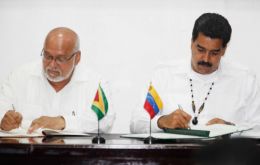
Venezuelan President Nicolas Maduro ended a one-day visit to Guyana on Saturday in a move that strengthens the relationship between the two countries that have had a long standing border dispute. The two countries have agreed to ask the Jamaica-born academic, Professor Norman Girvan to continue as the United Nations (UN) Good Officer as they seek to settle their border dispute.
-
Saturday, August 31st 2013 - 18:03 UTC
Unasur embarrassment: Suriname president’s son arrested by US on drug and arms trafficking

Suriname opposition legislators have called on President Desi Bouterse to resign as well as to clarify the circumstances surrounding the arrest of his son by United States law enforcement authorities in Panama earlier this week.
-
Saturday, August 31st 2013 - 17:46 UTC
Santos orders troops to patrol Bogotá as farm-protest reaches the capital
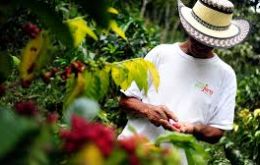
President Juan Manuel Santos ordered troops to patrol Bogota and Colombia's highways on Friday, after violent protests in support of striking farmworkers left two dead.
-
Saturday, August 31st 2013 - 15:27 UTC
Uruguay fearing the wrath of Cristina Fernandez denies authorization to expand pulp mill capacity

The Uruguayan government fearful of Argentine President Cristina Fernandez’s reaction will not authorize the local UPM pulp mill to expand its production capacity from 1 million to 1.3 million tons annually, in the short term, according to company and government sources.
-
Saturday, August 31st 2013 - 02:01 UTC
Sigh of relief for Mantega: Brazilian economy expands 1.5% in second quarter

Brazil’s economy expanded 1.5% in the second quarter of 2013 compared with the previous three month, exceeding the most optimistic market expectations, official statistics showed Friday. The farm sector fared best, growing 3.9%, followed by industry with 2% and services 0.8% according to the Brazilian Institute of Geography and Statistics (IBGE) website.
-
Saturday, August 31st 2013 - 01:50 UTC
“Doors are open for Aerolíneas whenever they wish” Chile tells Argentina
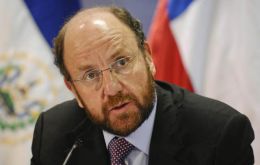
Chilean Foreign minister Alfredo Moreno said that flag carrier Aerolíneas Argentina can access the Chilean domestic market whenever they wish, discarding any impediments or veto to such an option.
-
Saturday, August 31st 2013 - 00:29 UTC
Paraguay and Venezuela resume political dialogue at Unasur summit
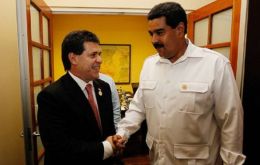
Paraguay and Venezuela presidents Horacio Cartes and Nicolas Maduro met on Friday for over half an hour following the mediation of Brazilian leader Dilma Rousseff during the Unasur summit taking place in Paramaribo, Suriname. The meeting was made official by the Paraguayan presidency office and twits from the Planalto Palace, seat of the Brazilian executive.
-
Thursday, August 29th 2013 - 23:54 UTC
Falklands’ Noble Energy exploring for oil in disputed Caribbean waters supported by Nicaragua
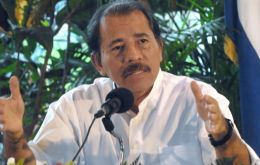
On 17 July, Nicaragua announced that US-based Noble Energy would invest 30 million dollars in drilling two offshore wells in the Caribbean—launching Nicaragua's first-ever oil exploration.
-
Thursday, August 29th 2013 - 03:50 UTC
Uruguay’s first lady praises Cristina Fernandez and blast opposition
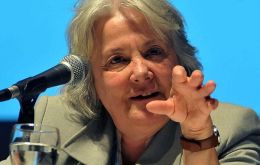
Uruguay’s First Lady and Senator Lucia Topolansky said that for her fellow countrymen having a dispute with Argentina is “like fighting with yourself” and described as ‘painful’ the several years long conflict between the two countries over the construction of the UPM (former Botnia) pulp mill on a shared river.