MercoPress. South Atlantic News Agency
Latin America
-
Friday, June 5th 2026 - 23:12 UTC
US sanctions Cuba's president Díaz-Canel and inner circle in push for regime change
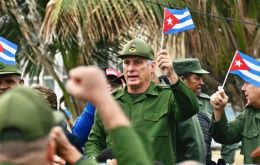
The United States sanctioned Cuban President Miguel Díaz-Canel and his closest circle on Thursday, in a fresh escalation of Washington's pressure on the island with the stated goal of forcing a change of regime after 67 years of communist government. Havana rejected the move at once.
-
Friday, June 5th 2026 - 22:49 UTC
Bolivia's blockade crisis reopens a deep racial divide
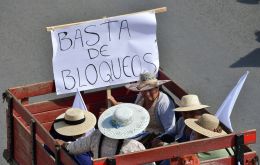
The social conflict in Bolivia has split the country once again. The road blockade led by Indigenous peasants, which has besieged La Paz for more than a month, has brought expressions of racism to the surface in the capital. Worn down by the lack of gasoline and food and by soaring prices, some residents lash out at the protesters —and the hostility runs in both directions.
-
Thursday, June 4th 2026 - 21:15 UTC
Colombian judge orders De la Espriella to stop using national team jersey in campaign
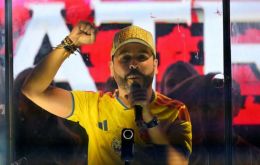
A Bogotá court ordered presidential candidate Abelardo de la Espriella and his party, Defensores de la Patria, to refrain from using the Colombian national football jersey at campaign events and in advertising, while it studies a constitutional protection action filed by a citizen. The provisional measure, issued on June 3 by the 120th Municipal Criminal Court, takes immediate effect and also covers social media and the press.
-
Thursday, June 4th 2026 - 15:11 UTC
Petro drops constituent assembly bid 17 days before Colombia's presidential runoff
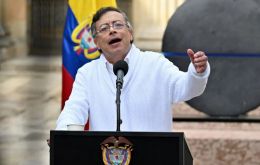
The committee that had promoted a National Constituent Assembly championed by Colombian President Gustavo Petro announced on Thursday that it was halting the collection of signatures and withdrawing the project to reform the 1991 Constitution. The decision, taken 17 days before the June 21 presidential runoff, seeks to clear the way for the governing bloc's candidate, Senator Iván Cepeda, in a move that reshapes the electoral landscape.
-
Wednesday, June 3rd 2026 - 16:54 UTC
Bolivia's blockade crisis risks tipping into civilian clashes, analysts warn
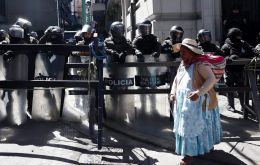
Bolivia's political crisis threatens to spill over into confrontations between urban and rural populations, after nearly a month of road blockades that have disrupted supplies of food, medicine and fuel —especially in the Andean region— and left at least nine people dead. Analysts Pedro Portugal and Gabriela Canedo warned of the danger in remarks to the news agency EFE, pointing to clashes fueled by an ethnic and cultural fracture and by the alleged inaction of Rodrigo Paz's government, whose resignation the mobilized sectors are demanding.
-
Tuesday, June 2nd 2026 - 10:50 UTC
La Paz endures a month of blockades as food and fuel shortages deepen
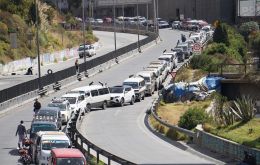
La Paz has spent a month under blockade. The main roads into Bolivia's administrative capital have been cut for four weeks, and shortages of food and fuel worsen by the day. Frustration is mounting among residents: some demand the resignation of President Rodrigo Paz for failing to keep his campaign promises, while others call for a firm hand and the deployment of the army to lift the siege. Most agree that the president, who took office less than seven months ago, should have acted sooner, when the protests began.
-
Monday, June 1st 2026 - 07:07 UTC
Colombia: far-right De la Espriella advances first to runoff as Petro disowns results
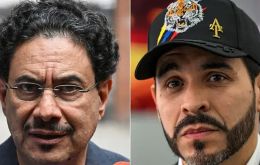
Far-right lawyer Abelardo de la Espriella took first place in the first round of the Colombian presidential elections held on Sunday, in a result that contradicted all previous polls and immediately opened an institutional crisis. With 99% of polling stations counted in the preliminary tally, De la Espriella, of the Defensores de la Patria movement, reached 43.7% of the vote —some 10.3 million ballots—, while leftist senator Iván Cepeda, of the ruling Pacto Histórico, obtained 40.9% with 9,649,081 votes. The runoff will be held on 21 June and the inauguration is scheduled for 7 August.
-
Sunday, May 31st 2026 - 19:30 UTC
Leftist Iván Cepeda leads in early bulletins of Colombia's presidential first round
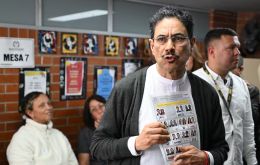
Leftist senator Iván Cepeda, candidate of the ruling Pacto Histórico coalition, was leading on Sunday in the early bulletins of the count in the first round of Colombia's presidential elections, in which the electorate was to choose the successor of current President Gustavo Petro. With just 1% of the polling stations counted, according to data released by the National Registry Office, Cepeda was obtaining around 47% of the votes, followed by far-right lawyer Abelardo de la Espriella, of the Defensores de la Patria movement, with close to 40%. Right-wing uribista senator Paloma Valencia, of the Centro Democrático, registered around 6%. The effective electoral turnout will be known over the coming hours, in a country with more than 41 million eligible voters and a long historical pattern of high abstention.
-
Friday, May 29th 2026 - 23:09 UTC
Colombia votes for new president with healthcare system on verge of collapse as main concern
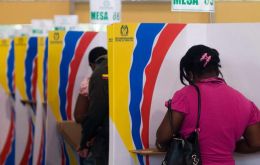
Colombia will hold on Sunday 31 May the first round of the presidential elections that will determine the succession of President Gustavo Petro for the 2026-2030 term, with an electoral roll of 41,287,084 voters and healthcare emerging as the electorate's main concern, according to opinion polls. The national health system is going through its most severe crisis in decades: pharmacies are denying medications, hospitals are closing services, and specialist appointments are indefinitely postponed. A possible runoff would be held on 21 June if none of the fourteen candidates surpasses 50% of the vote.
-
Friday, May 29th 2026 - 06:42 UTC
Argentina, Bolivia, Chile, Ecuador, and Peru sign joint agreement to combat transnational crime
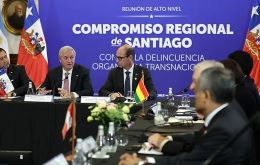
The governments of Argentina, Bolivia, Chile, Ecuador, and Peru on Thursday signed in Santiago a joint cooperation agreement against transnational organized crime, in a meeting convened by the Chilean government of President José Antonio Kast and attended by five foreign ministers, four security ministers, and one interior minister. The so-called Santiago Regional Compact articulates five areas of cooperation and will be presented before the 56th General Assembly of the Organization of American States to extend the initiative to the rest of the continent.