MercoPress. South Atlantic News Agency
Latin America
-
Tuesday, November 11th 2014 - 04:34 UTC
Minister Swire underlines business opportunities for UK companies in Paraguay

UK Minister for Latin America, Hugo Swire, spoke of the growing presence of UK in Latin America and more specifically on the expanding links with Paraguay. Minister Swire said UK was determined to deepen its commercial ties with a rising Latin America and described Paraguay as a perfect trade and investment partner for UK, particularly since British oil industry has struck oil in the Chaco region.
-
Monday, November 10th 2014 - 08:54 UTC
Cable & Wireless acquires major Caribbean telecoms company

Columbus International Inc., the fiber-based telecoms company which operates in the Caribbean as Flow, has been acquired by LIME parent company, Cable & Wireless Communications Plc. (CWC), in a 3bn dollars buyout deal announced last Friday.
-
Monday, November 10th 2014 - 07:34 UTC
Latam Energy Organization approves statement on “Malvinas sovereignty”
Energy ministers from the Latin American Energy Organization, OLADE, meeting in San Salvador approved last Friday a statement on “Malvinas Islands sovereignty” referred to the “illegal hydrocarbons exploration and exploitation undertaken in the Islands surrounding waters”, points out a release from the Argentine Foreign ministry.
-
Sunday, November 9th 2014 - 11:01 UTC
Uruguay leads the 'prosperity index' in Latin America and ranks 30 worldwide
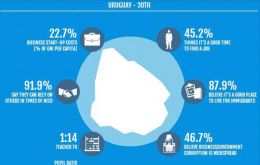
Uruguay is ranked in position 30 at global level among 'high prosperity' countries, according to the 2014 Legatum Prosperity Index, and remains at top position regarding Latin America. It's the same ranking as in 2013 and confirms Uruguay in the leading position for the region for several years running.
-
Sunday, November 9th 2014 - 10:23 UTC
Plaque dedicated to English soldiers in Cartagena triggers strong controversy
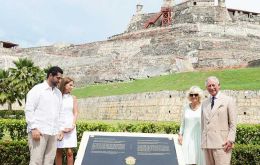
A Colombian engineer smashed a plaque commemorating the death in 1741 of thousands of English soldiers in the coastal city of Cartagena just days after it was inaugurated by Prince Charles, said the mayor of the city who has now ordered its removal.
-
Sunday, November 9th 2014 - 10:01 UTC
Mexico's cancels contract to build a high-speed passenger train link
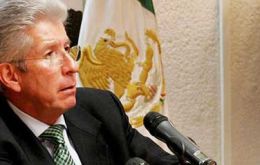
Mexico has abruptly cancelled a 3.75bn dollars contract awarded on Monday for a Chinese-led consortium to build a high-speed passenger rail link. President Enrique Peña Nieto said he wanted to avoid “any doubts about the legitimacy and transparency” of the bidding process.
-
Sunday, November 9th 2014 - 09:52 UTC
Antarctic ozone hole reached annual peak 11 September and with the size of North America

The Antarctic ozone hole reached its annual peak size on Sept. 11, according to scientists from NASA and the National Oceanic and Atmospheric Administration (NOAA). The size of this year’s hole was 24.1 million square kilometers, an area roughly the size of North America.
-
Saturday, November 8th 2014 - 06:11 UTC
Mexico in shock: gangsters admit having killed and burnt bodies of 43 students
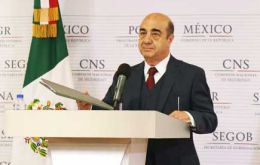
The 43 teacher trainees missing since a Sept. 26 incident in the southern state of Guerrero involving gangsters and corrupt cops are dead, Mexican Attorney General Jesus Murillo Karam said Friday, citing statements from three suspects in custody.
-
Wednesday, November 5th 2014 - 21:37 UTC
HMS Argyll hosts Prince Charles and Colombian president Santos in Cartagena
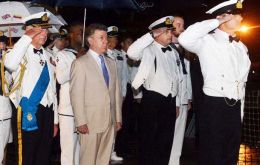
The Prince of Wales and The Duchess of Cornwall, accompanied by the President of Colombia, Juan Manuel Santos and First Lady Maria Clemencia Rodriguez, visited Royal Navy frigate HMS Argyll alongside in Cartagena de Indias, Colombia on Friday, 31 October. The party were introduced to members of the ship’s company and witnessed an evening sunset ceremony.
-
Wednesday, November 5th 2014 - 07:20 UTC
Cuba is asking for 8 billion dollars in investment from private corporations
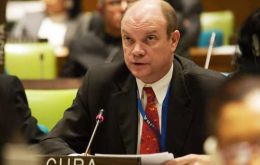
Cuba asked international companies on Monday to invest more than 8 billion dollars in the island as it attempts to kick-start a centrally planned economy starved for cash and hamstrung by inefficiency.

