MercoPress. South Atlantic News Agency
Mercosur
-
Monday, July 15th 2013 - 21:15 UTC
Former Brazilian official blasts his country policy towards Paraguay as ‘arbitrary, illegal and incompetent”
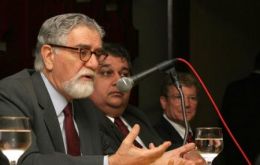
Brazil’s former Foreign minister Celso Lafer said that Paraguay was ‘arbitrarily’ excluded from Mercosur with a sanction that is not in conformity with the group’s charter and warned Brazil is losing international credibility in supporting Paraguay’s suspension because it is distancing itself from International law.
-
Saturday, July 13th 2013 - 13:44 UTC
Paraguay president elect demands Mercosur complies with International law
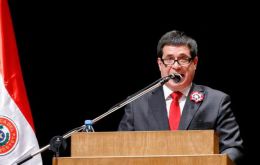
Paraguay president-elect Horacio Cartes made public a strongly supported legal statement rejecting the decision to give the pro-tempore presidency of Mercosur to Venezuela which was approved and confirmed on Friday at the group’s presidential summit in Montevideo, Uruguay.
-
Saturday, July 13th 2013 - 13:34 UTC
Mercosur blasts EU countries over Morales incident and condemn US electronic surveillance
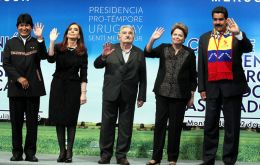
Mercosur leaders agreed on Friday to call home for consultation their ambassadors to Spain, France, Italy and Portugal to protest last week's forced diversion of the Bolivian president's aircraft. They also strongly defended their right to offer asylum Friday, venting anger at claims of US spying in the region while intelligence leaker Edward Snowden's fate hangs in the balance.
-
Saturday, July 13th 2013 - 02:24 UTC
“Mercosur has closed its doors to Paraguay”, reacts Asuncion to the Venezuelan presidency of the group
“Mercosur has closed its doors to Paraguay and it’s not good for Latinamerican integration”, was the first reaction from Asuncion after the group announced the presidency for Venezuela and lifting the suspension of Paraguay next 15 August.
-
Friday, July 12th 2013 - 23:00 UTC
Maduro pledges his priority as Mercosur chair is the full active return of Paraguay
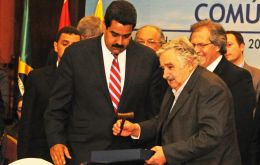
President Nicolas Maduro remembered former leader Hugo Chavez and pledged his main priority as president of Mercosur would be to ensure the quick return of Paraguay to the group. Maduro made the statement on Friday in Montevideo during the ceremony in which he received the official Mercosur presidency gavel from Uruguayan president Jose Mujica which means he will be holding the pro tempore chair for the next six months.
-
Friday, July 12th 2013 - 20:17 UTC
Belonging to Mercosur and the Pacific Alliance is ‘not incompatible’ says Uruguay
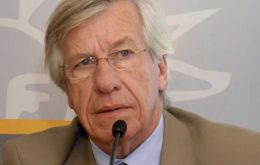
Uruguay Vice-president Danilo Astori said that belonging to Mercosur and the Alliance of the Pacific is ‘not incompatible’ and called on the ‘powerful members’ of Mercosur to support an agreement with the Pacific Alliance of which Uruguay and Paraguay are already observers.
-
Friday, July 12th 2013 - 08:33 UTC
Mercosur social summit criticizes the Pacific Alliance and blasts free trade
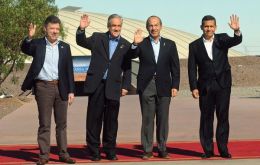
The Mercosur social summit questioned any possible approach to the Alliance of the Pacific since it is an organization entirely dedicated to trade which would distract the Southern Cone countries from their social objectives.
-
Friday, July 12th 2013 - 08:16 UTC
Mercosur will lift Paraguay’s suspension next August 15, announced Uruguay
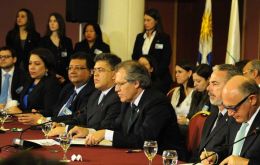
This coming August 15, Mercosur will lift the suspension on Paraguay's participations that has held since June 29 2012, Uruguay Minister Luis Almagro announced on Thursday during a meeting of the group’s foreign ministers in Montevideo.
-
Friday, July 12th 2013 - 07:50 UTC
With Guyana and Suriname all South American countries are Mercosur associates
Suriname and Guyana signed on Thursday the protocols to become associate members of Mercosur which is currently holding its mid year summit in Montevideo. This means all South American countries are now part of Mercosur.
-
Thursday, July 11th 2013 - 07:26 UTC
Summit in Montevideo could further expose the fragility of a Mercosur turned political
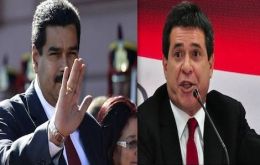
President-elect Horacio Cartes will not make any comments on the ongoing dispute of Paraguay with Mercosur until after the group’s summit in Uruguay next Friday, when official decisions on the subject are expected to be made public. However for both sides any decision will most probably be challenging and ratify that Mercosur has become a political group far from its original trade and investment purposes.

