MercoPress. South Atlantic News Agency
Tag: Falklands referendum
-
Friday, March 22nd 2013 - 06:10 UTC
Why the Falklands matter

By James Kirchick (*) - Americans might wonder why they should care about the fate of a tiny set of islands closer to Antarctica than to Florida, where penguins outnumber humans by more than 300 to 1. But the fate of the Falkland Islands — whose citizens expressed a near-unanimous desire to remain part of the United Kingdom this month — will set an important precedent for the universal principle of self-determination
-
Tuesday, March 19th 2013 - 02:27 UTC
Falklands: UK recalls that Vatican policy is they have no role to play in the dispute

The United Kingdom played down the request made by Argentine President Cristina Fernández to Pope Francis to intervene in the Falklands/Malvinas Islands sovereignty dispute and recalled the recent referendum with an overwhelming support from Islanders to remain a British overseas territory.
-
Monday, March 18th 2013 - 21:51 UTC
Falkland Islands’ post referendum musings and the ‘Britishness’ feeling

Writing for Penguin News its Deputy Editor, John Fowler, takes stock in the wake of the recent referendum in the Falkland Islands which resulted in a 92%turn out and 99.8% of voters opting to maintain the Islands current status as an overseas territory of Great Britain.
-
Monday, March 18th 2013 - 08:22 UTC
“The people of the Falklands have spoken clear and loud”, MLA Hansen tells Trinidad and Tobago
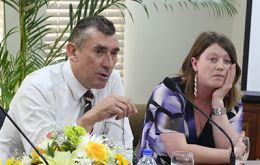
The Falkland Islands have spoken, and have spoken clearly and loud for all countries in the world to listen, said Ian Hansen, member of the elected Falkland Islands Legislative Assembly currently on a tour of Caribbean countries to deliver the message from the March 10/11 referendum.
-
Saturday, March 16th 2013 - 03:43 UTC
Falklands: PM Cameron anticipates Argentina’s intention of having Francis involved in the dispute

British Prime Minister David Cameron stated on Friday that Pope Francis had been wrong to say last year that Britain had “usurped” the Falkland Islands from Argentina, saying he respectfully disagreed with the new Pontiff. His words have been interpreted as a message anticipating the Argentine government’s possible attempts to get the new pope involved in the dispute.
-
Thursday, March 14th 2013 - 09:23 UTC
Falkland Islands’ referendum message to Argentina: “intimidation of Islanders must cease”

The Argentine government demands to control the Falkland Islands against the wishes of the people who live there are fundamentally incompatible with modern democratic values and attempts to intimidate the Islanders must cease, said Foreign Secretary William Hague in an update to Parliament.
-
Thursday, March 14th 2013 - 09:14 UTC
Falkland Islands’ referendum, Argentina should yield to reality and peoples’ self determination says Brazilian daily

Under the heading of “Malvinas: British” the influential Brazilian newspaper Folha de Sao Paulo describes the 99.8% result of the Falklands referendum as a “compelling defeat” for the Argentine government and a litigation hard to sustain when international law rests more on the peoples’ perspective than in the historic, real or imaginary territorial possession.
-
Thursday, March 14th 2013 - 09:03 UTC
Falkland Islands’ referendum: for Canada results are ‘very clear’ but for EC it was an ‘internal affair’

The Canadian government said on Wednesday that the results of the Falkland Islands referendum are “very clear” and “only” the people of the Islands are entitled to decide on their future. However the European Commission refused to get involved in the discussion arguing it is an “internal affair” of an EU member.
-
Thursday, March 14th 2013 - 08:58 UTC
Falkland Islands’ referendum vote blasted unanimously in both Houses of Argentina’s Congress

The Argentine Congress in extraordinary sessions held on Wednesday in both Houses unanimously rejected the Falkland Islands referendum in which the local population overwhelmingly decided to remain as a British Overseas Territory.
-
Wednesday, March 13th 2013 - 04:13 UTC
Falkland Islands’ message to Cristina Fernandez: we have absolutely no desire to be ruled from Buenos Aires

“President Cristina Fernandez, we have sent you a message: we have absolutely no desire to be ruled by the Government in Buenos Aires and we hope that now you might respect that”, said the spokesperson for the Falklands’ elected government in the aftermath of the referendum which showed the Islanders almost unanimously (99.8% of ballots) want to remain a British Overseas Territory.

