MercoPress. South Atlantic News Agency
Argentina
-
Monday, May 18th 2009 - 08:39 UTC
Sixth death of dengue disease in Argentina
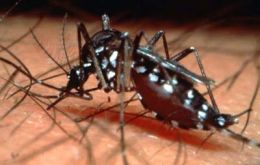
A sixth person has died of the mosquito transmitted dengue disease in Argentina. The Bolivian born victim died in the northern province of Salta of “dengue-shock syndrome”, which is a consequence of the more lethal form of the disease haemorrhagic dengue, reported the local daily “El Tribuno”.
-
Sunday, May 17th 2009 - 13:12 UTC
Private sector economists say Argentina is in recession

Argentina's industrial production in April plunged 9.1% on the year, economic think tank Orlando J Ferreres & Asociados reported this week. The April drop follows a 9% decline during the first quarter of 2009 and a 5.6% drop during the fourth quarter of 2008, according to the report.
-
Saturday, May 16th 2009 - 13:38 UTC
USDA estimates Argentine 2010 soy crop in 51 million tons, but…

United States Agriculture Department estimates Argentina’s soy bean production will reach a record 51 million tons in the 2010 crop. Such a volume would mark a complete turn around from this year’s crop which has been estimated anywhere between 34 and 31.7 million tons, or even less.
-
Saturday, May 16th 2009 - 13:03 UTC
Lula da Silva promotes use of local currencies for trade
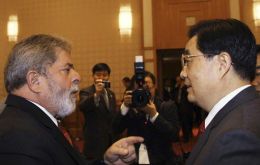
China and Brazil should conduct business with each other in their own currencies instead of the dollar, a publication quoted Brazil's president Lula da Silva as saying ahead of his trip to Beijing next week.
-
Friday, May 15th 2009 - 12:09 UTC
Uruguay’s president calls for “deeds” and an end to Argentine pickets

Uruguayan president Tabare Vazquez called for “deeds” from Argentina and insisted that the administration of Cristina Fernandez de Kirchner must remove the pickets which for two years have cut the traffic between the neighbouring countries in protest over the construction of a pulp mill.
-
Friday, May 15th 2009 - 11:49 UTC
Cristina plans to celebrate May 25th with Lula da Silva and Lugo

Argentine president Cristina Fernandez de Kirchner will celebrate the May Revolution National Day in a city bordering Brazil and Paraguay where she expects to hold a presidential meeting with her peer-neighbours, according to the Buenos Aires press.
-
Friday, May 15th 2009 - 11:29 UTC
Argentina lifts ban on direct flights from Mexico

The Argentine government announced on Thursday it would lift a ban on direct flights from Mexico imposed over two weeks ago due to an outbreak of the new H1N1 flu in that country.
-
Friday, May 15th 2009 - 09:29 UTC
Argentina tightens conservation for polaca, hoki and Patagonian toothfish
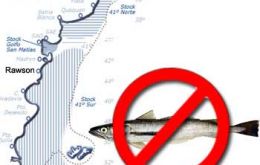
Argentina is tightening fisheries conservation in the South Atlantic. The Secretariat of Agriculture, Livestock, Fishery, and Food (SAGP&A) announced it will establish catch limits, intended to last 15 years, for polaca (Micromesistius australis), hoki (Macruronus magellanicus) and Patagonian toothfish (Dissostichus eleginoides).
-
Friday, May 15th 2009 - 02:46 UTC
Inflation guess game in Argentina: anywhere from 0.3% to 1.8%

Argentina's April inflation rate reached 0.3% and 5.7% in the last twelve months according to the latest release from the National Statistics Institute, Indec. The wholesale or production prices for the month was 0.5% and 1.7% since January, while the Construction Cost index rose 0.4% and 1%.
-
Thursday, May 14th 2009 - 08:21 UTC
Governance post-June 28 takes hold of Argentine electoral campaign
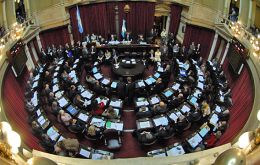
Argentine mid term elections have given a nasty turn as more opposition candidates are calling for “an orderly transition” that ensures governance from the day after June 28 until the end of the current presidential mandate of Cristina Fernandez de Kirchner.

