MercoPress. South Atlantic News Agency
Economy
-
Thursday, March 6th 2014 - 21:13 UTC
UK interest rate held at 0.5%, making it a record low of five years

UK interest rates have been held at 0.5% for another month, the Bank of England announced on Thursday. The decision by the Bank's Monetary Policy Committee comes five years after the record low level was first introduced.
-
Thursday, March 6th 2014 - 21:07 UTC
Fearing deflation Euro bank leaves interest rate unchanged at record low

The European Central Bank (ECB) kept on Thursday its benchmark interest rate at its record low of 0.25%, despite fears inflation could get stuck in a “danger zone” below 1%. The bank slightly raised its forecast for growth to 1.2% in 2014, but dropped its inflation estimate.
-
Thursday, March 6th 2014 - 05:53 UTC
February confirmed that inflation remains Uruguay's main challenge
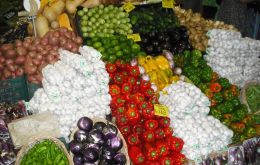
Inflation in Uruguay during February reached 1.66% which is equivalent to 9.82% in the last twelve months, the third highest in South America behind Venezuela and Argentina.
-
Thursday, March 6th 2014 - 05:38 UTC
US Supreme Court rules for British Gas in arbitration case against Argentina

The US Supreme Court ruled on Wednesday for British company British Gas Group Plc in its effort to reinstate a 185.3 million dollars arbitration award against Argentina that a US appeals court threw out.
-
Thursday, March 6th 2014 - 05:31 UTC
US budget battle takes off: Obama emphasizes combating poverty and helping middle class

President Barack Obama proposed new tax credits and job-training programs for US workers in a 2015 budget that drew instant condemnation from Republicans, who dismissed the document as an election-year campaign pitch.
-
Thursday, March 6th 2014 - 05:06 UTC
US government files 'friendly' support for Argentina before the Supreme Court

The Obama administration filed an ‘Amicus Curiae’ measure before US Supreme Court, supporting Argentina’s position in the dispute with the hedge funds which the government of president Cristina Fernández refers to as ‘Vulture Funds’.
-
Wednesday, March 5th 2014 - 04:52 UTC
China buys majority stake in Nidera as part of its investment in food assets

China's State-owned Chinese food giant Cofco Corp. on Friday announced it was buying a 51% stake in closely held grains trader Nidera NV. By investing in Dutch Nidera, Cofco--China's largest stated-owned grain trader-- would have greater control over pricing as well as better access to major grain-growing regions, such as Latin America and Russia.
-
Tuesday, March 4th 2014 - 23:44 UTC
Several Caribbean BOTs listed in the US 2014 narcotics control strategy report

The United States has named several Caribbean Community (CARICOM) countries as major money laundering states whose financial institutions engage in currency transactions involving significant amounts of proceeds from international narcotics trafficking.
-
Tuesday, March 4th 2014 - 23:35 UTC
YPF oil and gas production up in January but still not enough

Argentina's YPF increased oil and gas production by around 9% in January, continuing a trend that began in mid-last year in which the state-controlled firm reversed long-standing production declines. And while the rest of the sector continued to lag behind, oil production at least did experience a monthly increase, suggesting that YPF’s increases in output are starting to have a positive effect on the sector as a whole.
-
Saturday, March 1st 2014 - 05:12 UTC
Uruguay approves IMF test, but inflation and the neighbors could bring surprises

The International Monetary Fund lowered its forecast for economic growth in Uruguay this year to 3% from its previous estimate of 3.3%, the IMF's deputy managing director said on Friday in Montevideo. Naoyuki Shinohara told reporters that the revision is due to lower growth expected in Uruguay's neighbors Argentina and Brazil and lower prices for commodities and Uruguayan exports.

