MercoPress. South Atlantic News Agency
Economy
-
Tuesday, November 22nd 2011 - 17:30 UTC
EU/Latinamerica address bilateral relations and the growing influence of China

European and Latinamerican leaders agreed in Brussels that the two continents should continue to strengthen links in spite of the serious financial and economic situation facing the European Union.
-
Tuesday, November 22nd 2011 - 07:34 UTC
Unasur finance ministers and bankers meet in Argentina to address common agenda

Union of South American Nations, Unasur, Economy and Finance ministers will be meeting next Friday November 25 in Buenos Aires to address the current international crisis and advance in a common agenda. The meeting will also include Central bank presidents and governors.
-
Tuesday, November 22nd 2011 - 07:29 UTC
Cristina Fernandez admits “the model has distortions which must be corrected”

Argentine President Cristina Fernandez promised on Monday to continue defending with ‘tooth and nails’ the powerful wheel of domestic consumption that has boosted the current economic model but also admitted the existence of ‘distortions which must be corrected’.
-
Tuesday, November 22nd 2011 - 07:19 UTC
Argentine industry supports subsidy-elimination policy, but calls for gradualism

Argentine president Cristina Fernandez received strong support from the industrial sector for her latest policy of eliminating subsidies which are widely extended in the economy, but manufacturers also called for prudence and gradualism.
-
Tuesday, November 22nd 2011 - 03:54 UTC
Peruvian president at China trade forum: “we sell oranges and they send us marmalade”
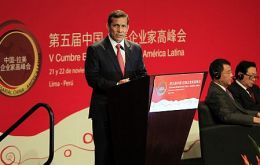
Peruvian President Ollanta Humala emphasized on Monday the importance of trade and investment relations with China, both for Peru and the region during the opening in Lima of the two-day 5th China-Latin America Business Summit
-
Tuesday, November 22nd 2011 - 01:46 UTC
World Bank loan to help Uruguayan farmers address climate change consequences
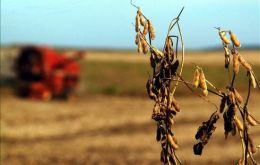
The World Bank approved last week a loan for 49 million dollars to support Uruguayan farmers in adopting environmentally sustainable practices to improve the resilience of their production systems in response to the effects of climate variability.
-
Tuesday, November 22nd 2011 - 00:40 UTC
Brazil imposes maximum fine on Chevron for oil spill, but more sanctions in the pipeline
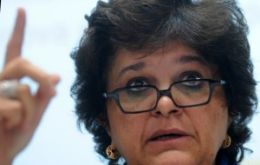
Brazil’s environmental agency said on Monday it will fine US Chevron 50 million Reais, nearly 28 million dollars, for a continuing oil spill off the coast of Rio de Janeiro and the company could face several more similar fines in the coming days.
-
Tuesday, November 22nd 2011 - 00:33 UTC
France in the Euro-debt firing line: Moody’s warns of negative outlook
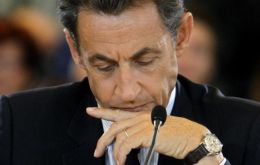
A rise in interest rates on French government debt and weaker growth prospects could be negative for the outlook on France's credit rating, Moody's warned in a report released Monday, adding to pressure on European debt markets.
-
Tuesday, November 22nd 2011 - 00:25 UTC
CNN poll shows same partisan divide on federal budget deficit cuts among US voters

The latest CNN poll shows that the same partisan divide that has kept the US congressional super committee from reaching a federal budget deficit reduction deal also exists among US voters who identify with a political party.
-
Tuesday, November 22nd 2011 - 00:19 UTC
US political stalemate as the Congress fails to agree on budget cuts and debt
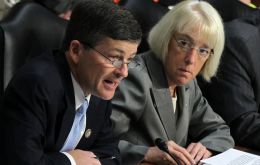
A special debt-reduction committee in the US Congress failed to reach agreement, extending partisan gridlock into the 2012 election year and setting the stage for 1.2 trillion dollars in automatic spending cuts.