MercoPress. South Atlantic News Agency
Economy
-
Sunday, March 13th 2016 - 23:17 UTC
Mercosur/EU will exchange trade proposals in April, is announced in Argentina
Mercosur and the European Union will exchange trade proposals in April, a key step for the long delayed trade and cooperation agreement between the two blocks and which has gained strength since the change of administration in Argentina with president Mauricio Macri.
-
Sunday, March 13th 2016 - 22:49 UTC
Argentina's government release of 2015 fiscal results triggers strong controversy
Argentina's Finance Ministry finally released its fiscal results for the 2015 period, which showed a deficit amounting to more than 5% of GDP. The figure is likely to be subject to much controversy and discussion, as the government of president Mauricio Macri introduced new methodology to calculate its figures.
-
Sunday, March 13th 2016 - 22:40 UTC
Oil at US$ 67 in Argentina has all the Majors converging

By Nick Cunningham of Oilprice.com
Argentina offers one of the few places on earth where oil companies are not suffering from the full force of the collapse in prices. Argentina regulates oil prices, a policy originally intended to insulate the public from the whims of the market, protecting people from triple-digit crude prices. But with the crash in prices since mid-2014, the effect of the regulation has reversed: motorists are now effectively subsidizing the oil industry. -
Sunday, March 13th 2016 - 22:22 UTC
Argentine bonds: US Appeals court puts on hold Judge Griesa's lifting of injunctions

United States appeals court put on hold a United States District Judge Thomas Griesa ruling lifting injunctions that have restricted Argentina from paying off some debts in light of the country’s US$6.5 billion offer to settle litigation over bonds in default since 2002.
-
Sunday, March 13th 2016 - 21:50 UTC
More than a million people fill the streets of Brazil demanding removal of Rousseff
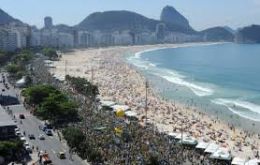
More than a million people have poured onto the streets of Brazil to demand the removal of the country's president Dilma Rousseff. The president is struggling to hold on to power in the face of a massive corruption scandal and the worst recession in decades.
-
Sunday, March 13th 2016 - 16:50 UTC
Brazil's largest party agrees that if Rousseff is forced out, Temer will replace her
Brazil's largest political party and decisive member of the ruling coalition said on Saturday it will take 30 days to decide whether to break with President Dilma Rousseff as she faces an impeachment battle. Calls within the Brazilian Democratic Movement Party, PMDB, to ditch the coalition have been growing as Rousseff faces a bruising recession, a spiraling corruption scandal and a probe of alleged electoral violations, as well as possible impeachment.
-
Saturday, March 12th 2016 - 07:21 UTC
France's Total ready to begin drilling offshore Uruguay: risky project but it could be AN ”elephant''
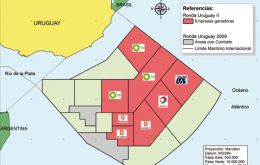
France’s Total SA announced it is preparing to begin drilling one of its most important offshore exploration wells in the Americas this year as it hunts for a giant oil field in Uruguayan waters. A discovery could extend an exploration boom in a country that currently imports all of its oil and gas needs.
-
Saturday, March 12th 2016 - 06:59 UTC
Brazilian political leaders discuss strategy in the event of a presidential removal
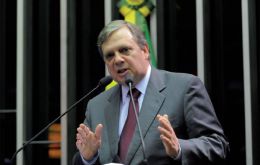
After expressing support for former president Lula da Silva, the Brazilian Democratic Movement Party (PMDB) met with main opposition leaders who are demanding President Dilma Rousseff be impeached. President of the Senate and member of the PMDB Renán Calheiros held extensive talks with the strongest opposition force, the Brazilian Social Democratic Party (PSDB), led by Aécio Neves, and agreed a joint strategy to face the crisis.
-
Friday, March 11th 2016 - 20:47 UTC
Odebrecht's involvement in Petrobras corruption scandal costing the conglomerate dearly

The Odebrecht group of companies, whose top officials have been sentenced to prison for involvement in the corruption scheme of Brazil's largest company Petrobras, has come under strong pressure from its creditors to use the crown jewel, the petrochemical company Braskem as collateral to avoid filing for bankruptcy.
-
Friday, March 11th 2016 - 20:06 UTC
Brazil's February inflation down, but central bank calls for structural reforms and budget control
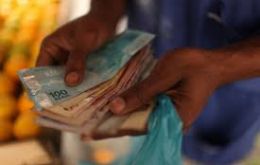
Brazil’s consumer-price index slowed in February, providing relief for the country’s central bank amid its efforts to curb inflationary pressures. The consumer-price index, IPCA, rose 0.90% in February, compared with an increase of 1.27% in January, the Brazilian Institute of Geography and Statistics, or IBGE, said.

