MercoPress. South Atlantic News Agency
Tag: Christine Lagarde
-
Thursday, June 14th 2018 - 22:14 UTC
IMF's Lagarde welcomes Argentina government’s economic policy plans
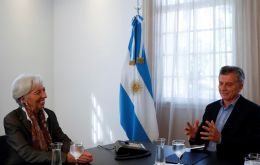
Argentine authorities have asked to use US$7.5 billion of the US$50 billion financing deal signed with the International Monetary Fund to fund their budget, IMF Managing Director Christine Lagarde said in a statement. Argentina’s Finance Ministry said in a separate statement that the funds would be sold on the market through pre-announced daily auctions conducted by the central bank.
-
Friday, June 8th 2018 - 07:30 UTC
IMF and Argentina agree on a 36-month US$ 50bn Stand-By Arrangement
The Argentine authorities and IMF staff have reached an agreement on a 36-month Stand-By Arrangement (SBA) amounting to US$50 billion (equivalent to about SDR 35.379 billion or about 1,110% of Argentina’s quota in the IMF). This staff-level agreement will be subject to approval by the IMF’s Executive Board, which will consider Argentina’s economic plan in the coming days.
-
Saturday, May 26th 2018 - 09:29 UTC
Protectionism the “darkest cloud” for the solid upswing of the global economy
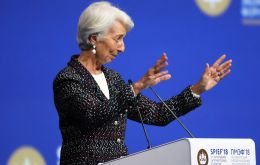
The threat of trade protectionism is the biggest concern looming over a solid upswing in the global economy, IMF managing director Christine Lagarde said. The “darkest cloud” on the economic horizon is the “determination of some to actually rock the system that has actually presided over the trade relationships that we have all undertaken and enjoyed to some extent over the last many decades”, said Lagarde.
-
Saturday, May 26th 2018 - 09:11 UTC
IMF/Argentina discussions to stabilize the economy are “progressing well”
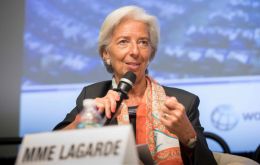
“We are really moving ahead and we have committed to President Macri that we will do the best we can in order to move expeditiously and efficiently in order to change the perception about Argentina and the perception that people have about our role,” Ms Lagarde said in Russia.
-
Friday, May 11th 2018 - 05:39 UTC
IMF and White House support Macri's economic reform program

International Monetary Fund chief Christine Lagarde said on Thursday she is ready to aid Argentina and wants talks on a financing package to be finalized quickly. Lagarde said she instructed the IMF team to continue discussions on a loan program with the goal to “reach a rapid conclusion.”
-
Wednesday, May 9th 2018 - 20:19 UTC
US Dollar rises: Uruguay behind Argentina
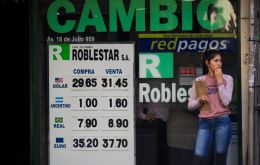
After several days up in Argentina, the devaluation of the Argentine peso and the rise of the US dollar have had some impact on the other side of the River Plate, where the exchange houses of downtown Montevideo marked on Wednesday the value of the currency up to 31,70 Uruguayan pesos per dollar, a rise of 2.08% compared to Monday —the highest in five years—. For the Uruguayan government, the country follows the global trend and calls for calm, beyond the noise generated in Argentina, which is beginning a dialogue between the Finance Minister, Nicolás Dujovne, and the International Monetary Fund (IMF) in Washington.
-
Wednesday, May 9th 2018 - 07:32 UTC
Peso storm: Argentina requests a US$ 30bn precautionary credit from IMF

Argentina asked the International Monetary Fund for financing to help stem a run from the Peso to the US dollar that is sparking a surge in interest rates and threatening to derail the country's economic recovery. The sum requested is estimated between 25 and 30bn dollars, 500% Argentina's IMF quota and could be disbursed in two forms, a flexible credit line or a precautionary credit line.
-
Saturday, May 5th 2018 - 07:24 UTC
Argentina hikes benchmark rate to 40%, easing pressure on the Peso but not on inflation
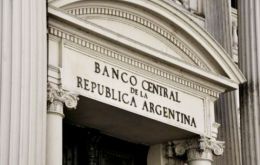
Argentina's Central Bank on Friday hiked its benchmark interest rate to 40% to support the peso, the third such hike in just over a week and one day after the currency plunged in value. Following the decision, the peso -- which has lost more than 10% of its value in the past month -- opened 6% higher against the dollar.
-
Tuesday, April 24th 2018 - 07:22 UTC
IMF forecasts Argentina will grow 2% this year because of the drought and fiscal shortcomings

The International Monetary Fund’s (IMF) World Economic Outlook update for April 2018 has reduced its expectations of growth for Argentina this year, and its projected annual inflation rate largely exceeds the 15% goal set by president Mauricio the Macri administration in December 2017.
-
Wednesday, March 21st 2018 - 06:41 UTC
Lagarde insists at financial G20: “we should fix the roof while the sun shines”
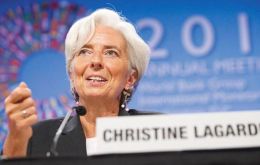
IMF Managing Director Christine Lagarde at the conclusion of the Group of 20 (G20) Finance Ministers and Central Bank Governors meeting in Buenos Aires, reiterated praise for Argentina president Mauricio Macri gradual economic policies, and called on the need for reform in the more advanced economies to ensure sustained, solid growth.