MercoPress. South Atlantic News Agency
United States
-
Thursday, June 28th 2012 - 08:02 UTC
US will wait for OAS report before deciding on Paraguayan situation

United States strongly supports the Organization of American States Council decision to send a top level delegation to Paraguay headed by Secretary General Jose Miguel Insulza, said on Wednesday US State Department spokesperson Victoria Nuland during the daily briefing.
-
Tuesday, June 26th 2012 - 06:25 UTC
US Supreme Court rules in favour of Argentina and unfreezes funds

The US Supreme Court on Monday rejected an appeal by two US investment funds that seek to seize 105 million dollars of Argentina's central bank deposits in New York to satisfy their claims from the country's huge debt default a decade ago.
-
Tuesday, June 26th 2012 - 03:54 UTC
Arizona immigration law pruned but police can check status of “suspected illegals”

The U.S. Supreme Court scaled back Arizona’s first-of-its-kind crackdown on illegal immigrants, striking down three provisions in a decision that asserts the federal government’s exclusive role to set immigration policy.
-
Monday, June 25th 2012 - 06:43 UTC
Argentina waiting for Obama administration to help balance bilateral trade

Ambassador in Washington Jorge Argüello said that the Argentine Government is concerned with the deficit increase in bilateral trade with the US and is waiting for Barack Obama administration actions to increase the purchase of Argentine goods.
-
Saturday, June 23rd 2012 - 07:53 UTC
US demands Argentina “immediately” ends the import licensing regime

The United States demanded on Friday that Argentina “immediately” end an import licensing regime and other curbs that have frustrated foreign suppliers while also expressing concerns about a “sweeping new import restriction” that Indonesia has imposed.
-
Wednesday, June 20th 2012 - 20:30 UTC
Federal Reserve extends monetary stimulus for another six months

The Federal Reserve extended on Wednesday its monetary stimulus to the US economic recovery renewing effort to depress borrowing costs by selling short-term bonds to buy longer-dated ones.
-
Tuesday, June 19th 2012 - 23:44 UTC
Coca Cola confronts NY Mayor Bloomberg: denies responsibility for US obesity epidemics
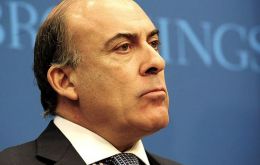
Coca-Cola CEO Muhtar Kent insists his company is not responsible for the rise in US obesity despite New York Mayor Michael Bloomberg's recent moves to limit the consumption of sugary drinks.
-
Saturday, June 16th 2012 - 05:54 UTC
US foreign military sales already a record 50 billion dollars, up 70% from 2011
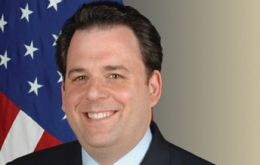
US Assistant Secretary of State for Political and Military Affairs Andrew Shapiro said that 2012 is already a record-breaking year for US foreign military sales, which are government-to-government sales.
-
Saturday, June 16th 2012 - 03:07 UTC
Parents of US child born in 2011 will spend 234.900 dollars until he is 17

The United States Department of Agriculture reported that a US middle-income family with a child born in 2011 can expect to spend about 234.900 dollars for food, shelter and other necessities to raise him or her over the next 17 years, an increase of 3.5% from 2010.
-
Saturday, June 16th 2012 - 03:03 UTC
“Who cares what an American official can think about the situation in Spain?”

Economics Nobel prize (2011) Thomas Sargent admitted feeling “ashamed” when some officials from the US government make recommendations to Europe, Spain and other countries on what policies they should adopt to climb out of the current crisis.

