MercoPress. South Atlantic News Agency
Argentina
-
Friday, May 25th 2012 - 06:51 UTC
Argentina revokes commuter railway concession involved in crash that killed 51m and injured 700
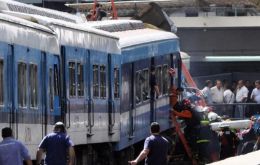
Argentina's government on Thursday revoked the commuter railway concession for a company whose train crashed in February, killing 51 people and injuring 703.
-
Friday, May 25th 2012 - 01:21 UTC
Argentina attacks WTO and US on trade issues at OECD ministerial round
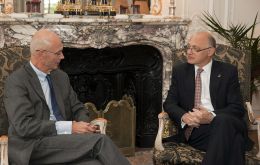
In an offensive to counter recent attacks on Argentina’s restrictive trade policies, Foreign Minister Hector Timerman expressed at the World Trade Organization, WTO, his government’s concern with the current course of global negotiations which face the serious risk of abandoning the development goals agreed when the launching of the current Doha Round of negotiations back in 2001.
-
Thursday, May 24th 2012 - 05:35 UTC
“Blue” dollar in Argentina reaches 6.15 Pesos; 36% gap over official exchange

Wednesday was another day of intense trading for the money exchange market in Buenos Aires with the “blue” or black market dollar reaching a new record, 6.15 Argentine Pesos, which for the first time was higher than the system used for getting dollars out of the country.
-
Thursday, May 24th 2012 - 05:15 UTC
Falklands’ lawmaker accuses Argentina of “indiscriminate and uncontrolled” fishing
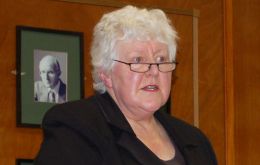
A member of the Falkland Islands elected Legislative Assembly criticized Argentina for “indiscriminate and uncontrolled” fishing and regretted the lack of cooperation in the conservation of South Atlantic fisheries.
-
Thursday, May 24th 2012 - 05:03 UTC
Spain now tells Argentina “YPF is no more than a bump” in a long shared history

Spanish Foreign Minister José Manuel García-Margallo adopted on Wednesday a conciliatory tone towards Argentina for the first time after the YPF seizure by saying Argentina and Spain should hold “kindred nation” talks.
-
Wednesday, May 23rd 2012 - 18:50 UTC
Following the Falklands’ ad incident Britain/Argentina at the opening hockey match in London
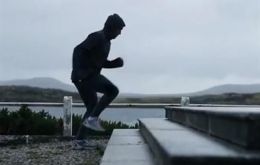
Britain’s men’s hockey team will play their opening match of the London Olympics against Argentina at 1900 BST on 30 July, one of whose players caused a controversy this month with a video filmed in the disputed Falklands/Malvinas islands.
-
Wednesday, May 23rd 2012 - 06:56 UTC
The US dollar stronger than the Euro in Argentina’s parallel market
For the second day running the Argentine Peso weakened against the US dollar climbing half a cent from Monday and closing at 4.43 and 4.48 on the local foreign exchange market.
-
Wednesday, May 23rd 2012 - 06:28 UTC
Ambassador Castro embroiled in controversy over Falklands and “possible constitutional reform”

Argentine ambassador in UK Alicia Castro rejects having mentioned during a conference in London the “possibility of a constitutional reform” to incorporate the results in the event of a sovereignty negotiation over the disputed Falklands/Malvinas Islands.
-
Wednesday, May 23rd 2012 - 03:59 UTC
Buenos Aires police de-activate bomb attack on former Colombian president Uribe

Former Colombian president Alvaro Uribe will carry on with his activities in Argentina as planned, despite the fact a bomb was found in a Buenos Aires theatre where he is expected to give a conference, according to sources close to the event organization
-
Wednesday, May 23rd 2012 - 03:56 UTC
Spain, on the edge of a financial cliff, cancels all development aid to Latin America
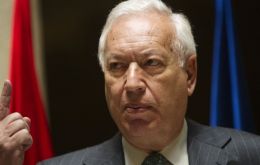
The Spanish government announced this week it was cancelling all development aid to Latin American countries as a direct consequence of the financial strains the EU member is suffering, which is the worst in decades with record unemployment of 24%.