MercoPress. South Atlantic News Agency
Tag: Iran
-
Wednesday, June 10th 2026 - 13:52 UTC
US launches strikes against Iran in retaliation for the downing of an Apache helicopter
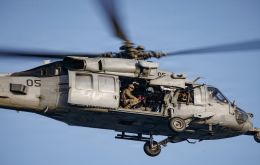
The United States launched a series of strikes against Iran on Tuesday in retaliation for the downing of a US Apache helicopter over the Strait of Hormuz, Central Command (Centcom) said. The action marks a sharp escalation that deepens doubts over the ceasefire in place since April 8 and over the peace negotiations that President Donald Trump says are within reach.
-
Sunday, June 7th 2026 - 21:24 UTC
Trump says he will urge Netanyahu not to retaliate after Iran's missile attack on Israel
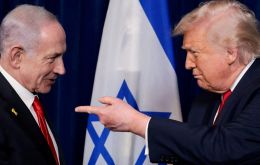
US President Donald Trump said he would call Israeli Prime Minister Benjamin Netanyahu to ask him not to respond to the missiles Iran fired at Israel on Sunday, in an effort to prevent a new escalation and salvage a deal with Tehran that he considers “very close.” It was Iran's first direct attack since the ceasefire reached on April 8.
-
Saturday, May 30th 2026 - 07:31 UTC
United States and Iran acknowledge preliminary agreement but disagree on its essential terms
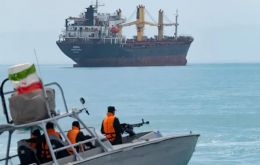
The administrations of US President Donald Trump and the Iranian government confirmed on Friday the existence of a preliminary agreement aimed at extending the current ceasefire by sixty days and opening formal talks on Iran's nuclear program, in what amounts to the most significant diplomatic advance since the start of the war three months ago. However, the versions disseminated by Washington and Tehran on the content of the understanding differ substantially on the central points: the reopening of the Strait of Hormuz, the fate of the highly enriched uranium under Iranian control, and the possible payment of frozen funds to the Islamic Republic.
-
Wednesday, May 27th 2026 - 18:00 UTC
Trump rejects Russia or China custody of Iranian enriched uranium in peace negotiations
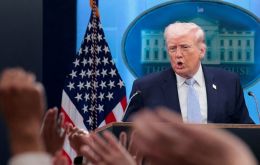
US President Donald Trump on Wednesday ruled out that Russia or China could take control of Iran's stockpile of enriched uranium as part of a possible agreement to end the war. “No, I would not be comfortable with that,” the president replied tersely to journalists who asked about the possibility of Moscow or Beijing taking custody of the radioactive material with which Tehran could potentially build a nuclear weapon. The statement introduces a new complication into the negotiations both parties are conducting in Doha under Qatari mediation.
-
Monday, May 25th 2026 - 22:11 UTC
United States strikes southern Iran targets “in self-defense” amid Doha peace talks
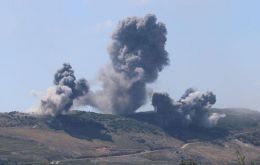
The US Armed Forces struck military targets in southern Iran on Monday “in self-defense,” according to a statement by US Central Command, in an episode that coincides with the arrival of Iranian negotiators in Qatar for peace talks mediated by the Qatari government. The operation also overlaps with the order issued by Israeli Prime Minister Benjamin Netanyahu to the Israeli army to “step on the accelerator” in its offensive against the Shiite militia Hezbollah in Lebanon, despite parallel negotiations between Tel Aviv and Beirut.
-
Monday, May 25th 2026 - 00:51 UTC
Trump administration anticipates imminent agreement with Iran to reopen Strait of Hormuz
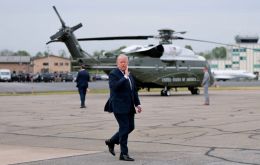
The administration of US President Donald Trump took it for granted on Sunday that within the coming days it will be able to announce an agreement with Iran to reopen the Strait of Hormuz, a maritime route through which approximately 20% of the world's oil flows and which has remained practically closed since the start of the US and Israeli offensive against the Islamic Republic on 28 February. Three months after the attack that killed Supreme Leader Ali Khamenei —replaced by his son Mojtaba— Washington and Tehran are negotiating a two-phase scheme that would ease pressure on the global economy without immediately resolving the underlying nuclear questions.
-
Monday, May 11th 2026 - 04:42 UTC
Trump calls Iran's response to his peace proposal “totally unacceptable”
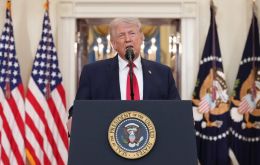
US President Donald Trump described Iran's response to Washington's latest proposal to end the war that has pitted the two countries against each other since 28 February as “totally unacceptable” on Sunday. “I have just read the response from Iran's so-called 'Representatives.' I don't like it — TOTALLY UNACCEPTABLE!” the president wrote on his Truth Social platform.
-
Monday, May 11th 2026 - 03:55 UTC
Trade, Iran and Taiwan dominate agenda of Trump-Xi summit beginning Wednesday in Beijing
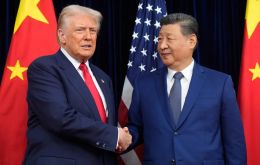
China confirmed on Monday that US President Donald Trump will pay a state visit from 13 to 15 May at the invitation of his Chinese counterpart, Xi Jinping. It will be the first trip by a US president to the country in nearly a decade —since Trump's own November 2017 visit— and will unfold against the backdrop of the US war against Iran, the fragile trade truce between the two powers, and the dispute over Taiwan's sovereignty.
-
Friday, May 8th 2026 - 01:20 UTC
Falklands brace for Middle East fallout with fuel, shipping and supply contingencies

The conflict in the Strait of Hormuz and its consequences for the global supply of oil and other derivative products have not bypassed the Falkland Islands, which, as one local lawmaker put it, sit “at the tail end of global distribution.”
-
Wednesday, May 6th 2026 - 01:45 UTC
Just one day after its launch, Trump halts Hormuz reopening operation and turns to negotiations with Iran
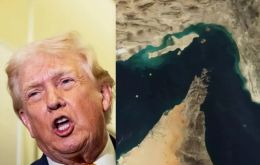
US President Donald Trump on Tuesday night announced the suspension of “Project Freedom,” the military operation launched barely 24 hours earlier to escort stranded vessels through the Strait of Hormuz, citing significant progress toward a peace agreement with Iran. The announcement, posted on his Truth Social platform, contradicted the messaging sustained throughout the day by Secretary of State Marco Rubio, Secretary of Defense Pete Hegseth, and Joint Chiefs chairman General Dan Caine, all of whom had framed the operation as a non-negotiable humanitarian rescue mission for stranded sailors.