MercoPress. South Atlantic News Agency
Economy
-
Tuesday, March 26th 2013 - 05:04 UTC
Falklands/Malvinas discussions between UK and Argentine lawmakers

Lawmakers from Argentina and the UK attending the 128th Inter-parliamentarian Union assembly held in Ecuador have been holding intense but ‘respectful’ discussions about the Falklands/Malvinas sovereignty dispute.
-
Tuesday, March 26th 2013 - 05:02 UTC
Brazilian supermarkets will not sell meat from cattle raised in Amazon rainforest
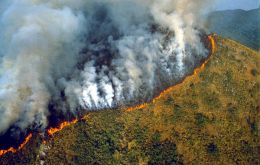
The main group representing supermarkets in Brazil says it will no longer sell meat from cattle raised in the rainforest. The Brazilian Association of Supermarkets, which has 2,800 members, hopes the deal will cut down on the illegal use of rainforest for pasture.
-
Tuesday, March 26th 2013 - 05:00 UTC
Bernanke defends low-interest rates arguing they help to boost the global economy

Ben Bernanke has defended the continuing low-interest-rate policies of the US Federal Reserve and central banks in Europe, saying they are helping to boost the global economy. The Fed governor's comments come after some analysts have voiced concern that such low rates are cutting the value of currencies of advanced nations.
-
Monday, March 25th 2013 - 05:16 UTC
EU, ECB and IMF agree on a deal to bailout Cyprus; no Parliament vote

Euro-zone finance ministers have agreed a deal on a 10bn-Euro bailout for Cyprus to prevent its banking system collapsing and keep the country in the Euro-zone. Asian financial markets rose in early trading on news of the deal.
-
Monday, March 25th 2013 - 04:45 UTC
Falklands ‘a NATO base’ and the referendum ‘unacceptable and ridiculous’, says Uruguay
Two of Uruguay’s President Jose Mujica closest ministers, Defence and Foreign Affairs said that the ‘British occupation’ of the Falkland Islands is ‘unacceptable’, represents a NATO base in the South Atlantic and described the recent referendum in the Islands as ‘absurd and ridiculous’.
-
Monday, March 25th 2013 - 01:26 UTC
Falklands: 'Yes' vote means 'we don’t want to be colonized by Argentina'
A delegation from the Falkland Islands recently visited Jamaica as part of a tour of North America, Central American and Caribbean countries to inform about the referendum earlier this month which resulted in a resounding 'yes' with only three 'no' votes, leaving no doubt as to their wish to remain a British Overseas Territory.
-
Sunday, March 24th 2013 - 03:11 UTC
Uruguay leaves benchmark rate unchanged; fears of slower economy and too strong Peso

Uruguay’s central bank surprised the market by keeping on hold the benchmark interest rate at 9.25% after increases at the two previous monetary policy meetings failed to slow inflation, one of the country’s main concerns.
-
Saturday, March 23rd 2013 - 10:17 UTC
As Cyprus collapses, it's a race to the Mediterranean gas finish line

By Jen Alic of Oilprice.com - Cyprus is preparing for total financial collapse as the European Central Bank turns its back on the island after its parliament rejected a scheme to make Cypriot citizens pay a levy on savings deposits in return for a share in potential gas futures to fund a bailout.
-
Friday, March 22nd 2013 - 21:23 UTC
Uruguay’s economic-trade relations with Argentina at ‘their worst moment in a long time’

The economic-trade relations with Argentina are going through ‘their worst moment in a long time’, and the latest measures announced by the government of President Cristina Fernandez have a ‘very harmful effect’ on Uruguay, said Vice-president Danilo Astori on Friday.
-
Friday, March 22nd 2013 - 21:16 UTC
World Bank outstands Uruguay as a success story in economic and social recovery

Under the heading of: “From crisis to opportunity: supporting an effective economic and social recovery with innovation and flexibility”, the World Bank outstands Uruguay as a success story, from the downfall of 2001/02, mainly consequence of the Argentine melting to the sustained recovery since 2004/05.