MercoPress. South Atlantic News Agency
Economy
-
Sunday, October 7th 2018 - 05:24 UTC
Bolsonaro clearly ahead for Sunday's vote in Brazil, leading with 40% intention

Pollster Datafolha released on Saturday evening its latest vote intention survey for Brazil's presidential election on Sunday 7 October, and it shows extreme right candidate Jair Bolsonaro leading with 40%, followed by Fernando Haddad from the Workers Party with 25% and Ciro Gomes, another left wing hopeful with 15%.
-
Saturday, October 6th 2018 - 09:10 UTC
Peso devaluation to affect Argentine households retroactively

Argentina's government Friday allowed home gas suppliers to charge extra as of January 2019 to make up for the recent devaluation of the peso against the US dollar.
-
Saturday, October 6th 2018 - 09:05 UTC
US economy booming: unemployment at its lowest in 50 years, even when September was soft
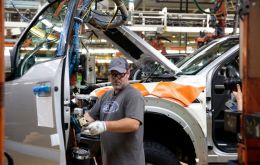
Jobs created in the United States during September fell to its lowest level in a year though the unemployment rate dropped to a point not seen in nearly 50 years, according to the Labor Department figures released Friday.
-
Saturday, October 6th 2018 - 09:02 UTC
Toyota recalls 2.43 million gasoline-hybrid vehicles for possible stalling

Toyota Motor Corp on Friday said it was recalling a total of 2.43 million gasoline hybrid vehicles at home and abroad over a hybrid system issue which can lead to stalling.
-
Saturday, October 6th 2018 - 09:00 UTC
Tokyo's traditional Tsukiji fish market closes down this Saturday

After years of delays Tokyo’s 83-year-old Tsukiji fish market is closing on Saturday to move to a more modern facility on reclaimed industrial land in Tokyo Bay. The new, US$ 5 billion facility at Toyosu will open Oct. 11, over the objections of many working in Tsukiji who contend the new site is contaminated, inconvenient and unsafe.
-
Friday, October 5th 2018 - 09:03 UTC
Industrial activity in Argentina down 5.6% in August and 0.8% in last 12 months

August data for industry was only a slightly better figure than the previous month – in July, a decline of minus 5.7% was witnessed. In June, the sharpest, most pronounced fall of the year was witnessed: 8.1%, year-on-year.
-
Friday, October 5th 2018 - 08:36 UTC
Argentine Peso slips on Thursday on prospects of higher US interest rates

Argentina’s Peso fell on Thursday, pressured by the recession-hit country’s dismal inflation outlook and higher U.S. interest rates that have pushed capital away from riskier emerging markets and toward the greenback, local traders said. The peso shed 1.85% to close at 38.4 per dollar after having gained 9.58% over the previous three days under a freshly-renegotiated International Monetary Fund financing deal that calls for tougher fiscal and monetary policy measures.
-
Friday, October 5th 2018 - 06:41 UTC
Falklands' offshore license relinquished by Noble Energy and Edison

Oil companies Noble Energy and Edison have decided to relinquish their stakes in the PL001 offshore license in the Falkland Islands according to Offshore Energy Today. Argos Resources had held a 100% in the PL001 block before the two companies’ farm-in back in 2015. Argos’ shares fell 30% following the announcement.
-
Friday, October 5th 2018 - 03:22 UTC
Emir of Qatar in Bs.Aires to meet with Macri over Vaca Muerta

The emir of Qatar, Sheikh Tamim Bin Hamad Al Thani, arrived Thursday evening in Argentina to meet with President Mauricio Macri on Friday to discuss oil investments in Vaca Muerta and other bilateral issues.
-
Thursday, October 4th 2018 - 18:16 UTC
Argentina makes solar heaters available in 25 zero-interest payments

As a part of Argentina's Energy Saving Program, the Banco de la Nacion Argentina announced a plan of 25 zero-interest payments to purchase solar water heaters through specific participating credit cards for home use.