MercoPress. South Atlantic News Agency
Tag: Caracas
-
Wednesday, December 12th 2018 - 08:36 UTC
Russian strategic bombers land in Venezuela; Maduro applauds, Washington furious
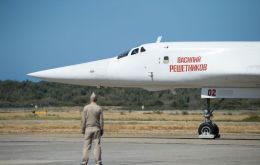
Two Russian strategic bomber aircraft capable of carrying nuclear weapons have landed in ally Venezuela, a show of support for Venezuela’s socialist government that has infuriated Washington
-
Sunday, October 28th 2018 - 16:50 UTC
Venezuela angered by Germany's joining list of countries that want Maduro before ICC
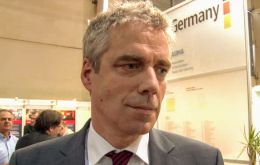
The Venezuelan Foreign Minister Friday summoned Germany's ambassador in Caracas, Daniel Kriener, to deliver a note of protest for Berlin's express support to an International Criminal Court (ICC) enquiry into alleged human rights violations by the Nicolás Maduro regime.
-
Thursday, August 30th 2018 - 08:29 UTC
Migrants returning to Venezuela following Maduro's promise of jobs
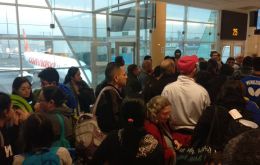
A group of Venezuelan migrants has returned home from Peru at the expense of Nicolas Maduro's government. Facing an exodus from Venezuela, Maduro had proclaimed his countrymen “won't be slaves to anyone in the world.”
-
Monday, May 21st 2018 - 08:33 UTC
Maduro re-elected, but with massive abstention and other candidates call for fresh elections
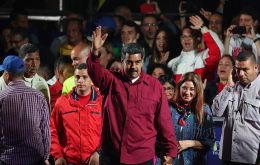
Venezuela’s populist leader Nicolas Maduro won a new six-year term on Sunday, but his main rivals disavowed the election alleging massive irregularities in a process critics decried as a farce propping up a dictatorship. Victory for the 55-year-old former bus driver, who replaced Hugo Chavez after his death from cancer in 2013, may trigger a new round of western sanctions against the populist government as it grapples with a ruinous economic crisis.
-
Friday, May 18th 2018 - 09:06 UTC
Maduro wraps up electoral campaign next to Erdogan and Maradona

Venezuela's diplomatically isolated president got a show of support from his Turkish counterpart Tayyip Erdogan and Argentine soccer legend Diego Maradona on Thursday ahead of a weekend election widely decried as unfair. The United States, the European Union and major Latin American countries have criticized Sunday's vote in which populist President Nicolas Maduro is likely to win re-election to a six-year term.
-
Wednesday, May 16th 2018 - 08:53 UTC
Kellogg pulls out of Venezuela. Maduro promises to hand control of the factory to workers
The United States based cereal maker Kellogg is pulling out of Venezuela because of the economic deterioration in the country. Workers said they were prevented from entering the plant in the central city of Maracay on Tuesday. The announcement comes ahead of Sunday's presidential elections.
-
Wednesday, February 28th 2018 - 11:09 UTC
UK academic cooperation with Venezuela on Climate Change
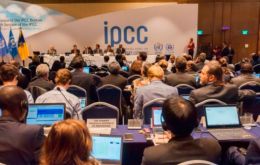
On 21 February, the First Academic Report on Climate Change was presented in Caracas with a conference by Dr. Antonina Ivanova, member of the Intergovernmental Panel on Climate Change (IPCC).
-
Monday, February 12th 2018 - 13:18 UTC
Climate change is increasingly notorious and alarming

The global climate perspective is darkened by a climate change that has accelerated in recent years and is becoming increasingly difficult to reverse. The ambitious temperature limits established in the Paris agreement are about to be overcome. Among its consequences, it is revealed that at least 26 million people will be dragged into poverty annually due to climatic causes and the retreat of the ice in the poles and mountain glaciers accelerates exponentially.
-
Saturday, February 10th 2018 - 09:26 UTC
New British ambassador presents Letter or Credentials to President Maduro

The British Ambassador to Venezuela, Andrew Soper, presented his Letter of Credentials to President Nicolás Maduro during a ceremony at the Miraflores Presidential Palace in Caracas.
-
Saturday, February 3rd 2018 - 16:31 UTC
Venezuelan police radio recording reveals that Oscar Pérez would have surrendered before dying
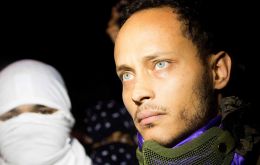
In audio filtered to Univisión (1), the radio transmission among the Venezuelan police forces that participated on the morning of January 15 in the capture operation against a revolt pilot Óscar Pérez and six of his companions carried out outside of Caracas is revealed. In the revealed material, the commander of the operation, Major of the National Guard Rafael Bastardo confirms his surrender.