MercoPress. South Atlantic News Agency
Tag: Mauricio Macri
-
Saturday, January 20th 2018 - 09:21 UTC
Argentina posted a primary fiscal deficit of 3.9% of GDP during 2017
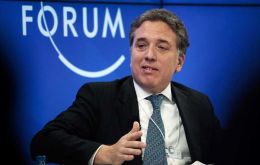
Argentina posted a primary fiscal deficit worth 3.9% of GDP in 2017, below its 4.2% goal and the 4.6% figure posted in 2016, Treasury Minister Nicolas Dujovne told reporters. He said the government’s 2018 target for a primary fiscal deficit remained at 3.2% of GDP, with targets of deficits worth 0.6% in the first quarter, 1.6% in the second quarter and 2.2% in the third quarter.
-
Saturday, January 20th 2018 - 09:15 UTC
Argentina's GDP expanded 2.9% in 2017, bouncing from a 2.2% retraction in 2016

Argentina’s gross domestic product (GDP) expanded by 2.9% in 2017, and grew 0.7% in the fourth quarter from the third quarter, a Treasury Ministry source said on Friday, bouncing back from a 2.2% contraction the prior year.
-
Tuesday, January 16th 2018 - 10:09 UTC
Vatican protocol message to President Macri when Pope overflew Argentina
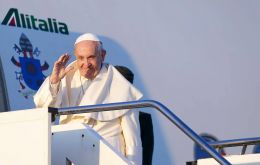
While overflying Argentine territory on Monday, in his trip to Chile for a three-day visit, Pope Francis sent his “warm greetings” to President Mauricio Macri and called on his fellow Argentines not to forget to pray for him, in his twenty second apostolic trip, which also includes Peru.
-
Saturday, January 13th 2018 - 07:58 UTC
Argentine union leaders warn Macri, and forecast he may not end his mandate
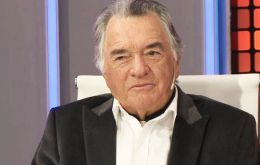
The Argentine government approach to the power challenge from strong unions has managed so far to have several of its leaders indicted for money laundering, fraud, racketeering and widespread corruption, including one who is jailed in neighboring Uruguay and which the Argentine justice expects to extradite.
-
Friday, January 5th 2018 - 10:44 UTC
Crackdown on phantom employees, “gnocchi”, in the Argentine Congress
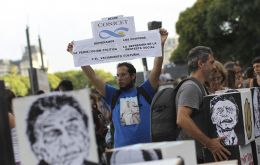
Nearly 200 phantom workers at Argentina's parliament have been caught in a crackdown on employees who only show up sporadically for their jobs, it has been reported. According to La Nacion, the Argentine Congress implemented a new attendance control system for employees two months ago, and it has already caught 190 who had not shown up for long periods without a good explanation.
-
Friday, January 5th 2018 - 10:20 UTC
Argentina sells US$ 9bn in bonds, “at the lowest yields in the country's history”
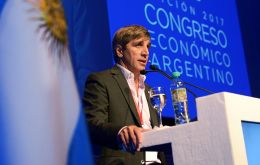
Argentina sold US$ 9 billion in a three-part dollar bond issuance that was oversubscribed on Thursday, covering nearly a third of its expected financing needs for 2018 early in the year. Latin America’s third largest economy sold US$1.75 billion in five-year bonds at a yield of 4.625%, US$ 4.25 billion of 10-year bonds at 6% and US$3 billion in 30-year bonds at 7%, the ministry said. It said the yields were the lowest in Argentina’s history.
-
Sunday, December 31st 2017 - 10:48 UTC
IMF report on Argentina: good, but watch out borrowing to finance the budget deficit

The International Monetary Fund (IMF) on Friday raised its outlook for Argentina’s economic growth to 2.8% in 2017, up from 2.5% seen in October, while keeping its forecast for 2018 growth steady at 2.5%.
-
Friday, December 29th 2017 - 09:38 UTC
Argentina's Merval breaks the 30.000-point barrier and ends 2017 gaining 77%
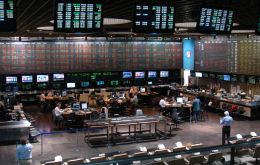
Merval, the benchmark stock market index in Argentina, ended Thursday's last trading session of 2017 above the 30,000-point barrier for the first time in history. The index rose 2.84% to 30,024.24 after the local government increased the inflation target for the next couple of years, but reinforced its commitment to lower fiscal deficits in the future.
-
Thursday, December 28th 2017 - 10:30 UTC
Argentine Senate approves tax reform and 2018 budget; economy expanded 0.2% in October
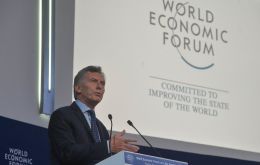
Argentina’s Senate on Wednesday gave final approval to the government’s tax reform and 2018 budget plan, part of President Mauricio Macri’s push to cut business costs and attract investment to Latin America’s No. 3 economy.
-
Wednesday, December 27th 2017 - 09:36 UTC
Moody's expects Argentine economic recovery in 2018 and 2019
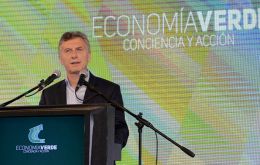
Credit risk rating agency Moody's expects Argentina's economic recovery to continue in 2018 and 2019, helped by the reforms advanced by the Mauricio Macri's administration in the last two years.