MercoPress. South Atlantic News Agency
Economy
-
Thursday, February 28th 2019 - 09:15 UTC
US trade deficit widens sharply in December: imports increase, exports drop

The US trade deficit widened sharply in December as slowing global demand and a strong dollar weighed on exports, another sign that economic growth slowed in the fourth quarter. Other data from the Commerce Department on Wednesday showed new orders for US-made goods barely rose in December and business spending on equipment was much weaker than previously thought, pointing to a softening in manufacturing activity.
-
Thursday, February 28th 2019 - 09:10 UTC
China's manufacturing activity shrinks for a third straight month in February
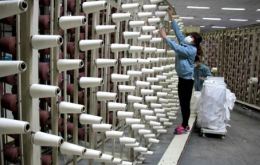
China's manufacturing activity shrank for a third straight month in February, sinking to its worst performance in three years as the economy slows and the US trade war bites, official data showed on Thursday. The Purchasing Managers' Index (PMI), a gauge of factory conditions, came in at 49.2 for the month, down from 49.5 in January, according to the National Bureau of Statistics (NBS).
-
Thursday, February 28th 2019 - 08:37 UTC
Brazilian consortium interested in Ford's Sao Paulo manufacturing plant

Brazilian automaker CAOA, which produces vehicles with Korea’s Hyundai Motor Co and China’s Chery Automobile Co, is in talks to buy a Ford Motor Co plant in the country that is slated to close by 2019, according to sources reported in the Sao Paulo media.
-
Thursday, February 28th 2019 - 08:23 UTC
Investigation into Odebrecht corruption network in the Netherlands

Prosecutors raided locations across the Netherlands on Tuesday as part of an investigation into the alleged use of shell companies to distribute US$ 100 million in bribes on behalf of Brazilian conglomerate Odebrecht SA.
-
Wednesday, February 27th 2019 - 09:27 UTC
Orthodox, US trained economist, Campos Neto confirmed as Brazilian central bank governor

Brazil's Senate-confirmed Roberto Campos Neto as central bank governor on Tuesday, after he stressed that controlling inflation and reining in public spending were critical to supporting economic growth.
-
Tuesday, February 26th 2019 - 09:07 UTC
Trump anticipates a “signing summit” with China's Xi: trade agreement “very, very close”

US President Donald Trump said on Monday he expects to hold a “signing summit” with China’s President Xi Jinping to seal a trade deal, since negotiators are “very, very close” to an agreement. Cheering global stock markets, the new comments confirm the dispute will not ratchet up immediately, averting an even bigger impact on the global economy.
-
Monday, February 25th 2019 - 09:15 UTC
PM May considering delaying Brexit deadline for two months

Prime Minister Theresa May is considering a plan under which Britain’s exit from the European Union would be delayed for up to two months, the Telegraph reported on Sunday. British government officials have drawn up a series of options, which were circulated at the weekend, in a bid to avoid resignations by ministers determined to support a backbench bid to take a “no deal” Brexit off the table this week, according to the Telegraph.
-
Monday, February 25th 2019 - 09:09 UTC
Ecuador reaches an agreement with IMF and will receive US$ 4.2 billion

Ecuador and the International Monetary Fund (IMF) staff have reached an agreement on a set of policies to underpin a US$4.2 billion (435% of quota and SDR3.035 billion) arrangement under the IMF’s Extended Fund Facility (EFF). This arrangement, which is subject to IMF Executive Board approval, would provide support for the Ecuadorian government’s economic policies over the next three years.
-
Monday, February 25th 2019 - 08:58 UTC
US/China trade talks make “substantial progress”; Trump delays deadline for more tariffs
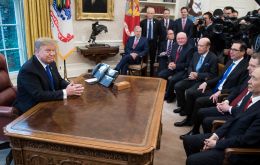
The United States is delaying a planned increase of tariffs on more than US$200 billion in Chinese exports after “substantial progress” made in trade talks, President Donald Trump said on Sunday. Trump also said he planned to hold a summit with Chinese President Xi Jinping at his Florida estate Mar-a-Lago to ink a deal.
-
Monday, February 25th 2019 - 08:27 UTC
Apocalyptic scenario for Brazil if pensions' reform is not approved, warns Economy ministry

Brazil’s Economy Ministry warned that the economy will slip into recession next year and official interest rates could more than double unless Congress approves measures to reduce the deficit in the country’s pension system.