MercoPress. South Atlantic News Agency
Economy
-
Friday, March 23rd 2018 - 09:06 UTC
Argentina expanded 2.9% last year; 2018 challenging given the persistent drought effect on crops

Argentina's economy expanded 2.9% in 2017 from the prior year and 3.9% in the fourth quarter versus the same period in 2016, the Indec statistics agency said this week. The year-over-year figure was slightly above the 2.8% annual growth rate given last month by Argentina's monthly economic activity indicator, seen as a proxy for gross domestic product.
-
Thursday, March 22nd 2018 - 22:22 UTC
Bank of England leaves rates unchanged for now, waiting for more Brexit data

The Bank of England signaled on Thursday that it remains on course to lift interest rates in Britain this year and next, as figures showed a yearlong squeeze on consumers caused by a steep fall in the pound appears to be coming to an end.
-
Thursday, March 22nd 2018 - 22:16 UTC
Trump calls for reciprocity and reveals US$ 60bn tariffs in China imports
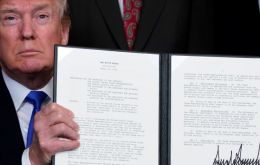
President Donald Trump announced on Thursday his plans for tariffs on up to US$60 billion annually in Chinese imports, designed as retaliation for an administration report that will outline Beijing’s violation of U.S. intellectual property rights.
-
Thursday, March 22nd 2018 - 14:53 UTC
Cambridge Analytica partner in Brazil under prosecutor investigation

Brazilian prosecutors on Wednesday said they had opened an investigation into whether London-based political consultancy Cambridge Analytica acted illegally in Brazil, as controversy over the firm’s data harvesting practices spreads across the globe.
-
Wednesday, March 21st 2018 - 20:25 UTC
Powell's Fed confirms gradualism: anticipates 5 more modest rate increases in next 21 months
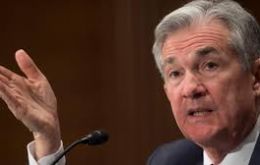
The Federal Reserve is raising its benchmark interest rate to reflect a solid U.S. economy and signaling that it's sticking with a gradual approach to rate hikes for 2018 under its new chairman, Jerome Powell. The Fed said it expects to increase rates twice more this year. At the same time, it increased its estimate for rate hikes in 2019 from two to three, reflecting an expectation of faster growth and lower unemployment.
-
Wednesday, March 21st 2018 - 10:03 UTC
Financial leaders reject protectionism, but prepare for a trade war

The world’s financial leaders rejected protectionism on Tuesday and urged “further dialogue” on trade, but failed to diffuse the threat of a trade war days before U.S. metals tariffs take effect and Washington is to announce measures against China. Finance ministers and central bankers of the world’s 20 biggest economies, which represent 75% of world trade and 85% of global gross domestic product, discussed trade disruptions as a risk to growth at a two-day meeting.
-
Wednesday, March 21st 2018 - 07:49 UTC
Falklands' air service upgrading avionics of its fleet of Islanders

Britten-Norman has reported that it completed the first in a series of avionics upgrades to a fleet of five BN2B-26 Islanders owned and operated by the Falkland Island Government Aviation Services (FIGAS). The avionics are being upgraded to the Garmin G600 glass cockpit standard including the GTN650/750 GPS/NAV/COMM, GTX335R remote transponder and electronic engine instruments.
-
Wednesday, March 21st 2018 - 07:37 UTC
UK inflation drops to 2.7% in February, weakest increase since July 2017

UK inflation was weaker than expected in February easing some of the squeeze on households' spending power but doing little to change bets on a Bank of England rate rise in May. Official data showed consumer prices rose by an annual 2.7% last month, the weakest increase since July of last year and down from a rise of 3.0% in January.
-
Wednesday, March 21st 2018 - 07:07 UTC
Mercosur “blocks” talks on auto exports and government procurement contracts, claims EU

European officials said this week that significant obstacles remain to a long-delayed trade deal between the European Union and Mercosur, even as South American officials expressed optimism a deal would be finalized soon.
-
Wednesday, March 21st 2018 - 06:41 UTC
Lagarde insists at financial G20: “we should fix the roof while the sun shines”
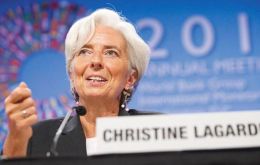
IMF Managing Director Christine Lagarde at the conclusion of the Group of 20 (G20) Finance Ministers and Central Bank Governors meeting in Buenos Aires, reiterated praise for Argentina president Mauricio Macri gradual economic policies, and called on the need for reform in the more advanced economies to ensure sustained, solid growth.